Subject-specialist worked solutions — every mark explained. Topical & Yearly Solved, Revision Notes, Predicted Papers. Explore →

Exam Intelligence · 6 Official Documents Analysed

How to Score Higher in Cambridge AS & A Level Biology (9700)

Evidence-based Biology 9700 exam guide built from official examiner reports and mark schemes. Specialised and comprehensive study tips — specific, cited insights so you can achieve top grades.

Evidence-BasedBuilt from 6 official examiner reports & mark schemes (2023–2025)

What Are Assessment Objectives (AOs)?

Before we dive in, you need to understand how Cambridge actually marks your answers.

AO stands for Assessment Objective. Think of AOs as the different “skills” Cambridge tests you on in every single question. When an examiner marks your paper, they don't just give you a mark out of 12 based on how “good” your answer feels — they allocate specific marks to each AO separately.

For example, a 12-mark question might be split as: AO1 (2 marks) + AO2 (2 marks) + AO3 (2 marks) + AO4 (6 marks). If you write a perfect textbook answer but don't evaluate, you can only score 6 out of 12 — because the other 6 marks are specifically reserved for evaluation.

This is why understanding AOs matters: they tell you exactly what the examiner is looking for and how many marks each skill is worth. Here are the 3 AOs for this subject:

AO1

Knowledge and Understanding

40% of AS Level; 40% of A Level (50% of Papers 1, 2 and 4)

Recall and show understanding of biological facts, terminology, concepts, and conventions. Precise terminology is critical — examiners penalise vague or interchanged terms (e.g. 'water concentration' loses marks, 'water potential' earns them).

AO2

Handling, Applying and Evaluating Information

40% of AS Level; 40% of A Level (50% of Papers 1, 2 and 4)

Interpret data, draw conclusions from unfamiliar contexts, perform calculations (including Hardy-Weinberg), and apply biological knowledge to novel situations. Data quotes must include both axes and exact values.

AO3

Experimental Skills and Investigations

20% of AS Level; 20% of A Level (100% of Paper 3; 100% of Paper 5)

Plan experiments and investigations; collect, record and present observations, measurements and estimates; analyse and interpret experimental data to reach conclusions; evaluate methods and experimental quality and suggest improvements. Assessed entirely through Paper 3 (Advanced Practical Skills) and Paper 5 (Planning, Analysis and Evaluation).

The key takeaway: Most students lose marks not because they lack knowledge (AO1), but because they skip the higher-order skills — building chains of reasoning (AO2) and making supported judgements (AO3). Everything below shows you exactly how to hit each AO based on what examiners have written in their reports.

🚫

Top Mistakes in AS & A Level Biology 9700

The most common reasons students lose marks in AS & A Level Biology 9700, cited directly from official examiner reports across multiple sessions.

1

Confusing similar scientific terms with very different meanings

Every examiner report across all sessions (2023–2025) · Affects: Paper 2, Paper 4

What examiners say

Pairs of similar scientific terms with very different meanings were sometimes confused. For example, some candidates mixed up antibiotics and antibody, antibodies and antigens, and introns and exons.

Paper 2, March 2023

Many wrote about active sites and substrates rather than antigen-binding sites and antigens. Many also included the term 'lock and key' in these answers.

Paper 2, May/June 2024

How to fix this

Make flashcards for commonly confused pairs: antibody/antigen, antibiotic/antibody, intron/exon, gene/allele, centromere/centrosome, primary transcript/mRNA, collagen molecule/collagen fibre, smooth muscle/elastic tissue. Test yourself by defining each without looking.

2

Using 'water concentration' instead of 'water potential' in osmosis

Every session, Papers 2 and 4 · Affects: Paper 2, Paper 4

What examiners say

Candidates should use the terms 'water potential' and 'water potential gradient'. The terms 'water concentration' and 'water concentration gradient' are not appropriate.

Paper 2, March 2025

It is incorrect to describe water moving down a concentration gradient.

Paper 4, May/June 2024

How to fix this

Always write 'water potential' (never 'water concentration'). Water moves from higher water potential to lower water potential. A more negative water potential means lower water potential. Pure water has a water potential of zero.

3

Imprecise membrane naming — saying 'membrane' instead of the specific membrane

Flagged in every Paper 2 and Paper 4 report · Affects: Paper 2, Paper 4

What examiners say

Candidates should be clear when referring to a specific membrane. If it is the membrane that surrounds the cell, it must be referred to as a cell surface membrane.

Paper 4, May/June 2023

How to fix this

Always specify WHICH membrane: 'cell surface membrane' (not just 'membrane'), 'inner mitochondrial membrane', 'thylakoid membrane', 'presynaptic membrane', 'postsynaptic membrane', 'tonoplast'. Just saying 'membrane' is too vague to earn marks.

4

Saying energy is 'made', 'lost', or 'produced' instead of released/transferred

Every Paper 4 report · Affects: Paper 4

What examiners say

Candidates should be reminded that energy is not made or destroyed, so phrases such as 'energy is lost' or 'energy is made' are not creditworthy.

Paper 4, May/June 2024

How to fix this

Energy is RELEASED (in exothermic reactions like respiration) or TRANSFERRED (between molecules or locations). Never say energy is 'made', 'produced', 'lost', or 'used up'. Say 'energy is released from the hydrolysis of ATP' not 'ATP produces energy'.

5

Hardy-Weinberg calculation errors — wrong starting point for p and q

Every Paper 4 report with genetics questions · Affects: Paper 4

What examiners say

Frequent errors included identifying q as the frequency of the recessive genotype instead of the frequency of the recessive allele, not multiplying 2pq by the population size.

Paper 4, March 2025

The values of p, q, p², 2pq and q² can never be negative or greater than one.

Paper 4, March 2025

How to fix this

Step-by-step: (1) q² = frequency of homozygous recessive phenotype, so q = √(q²). (2) p = 1 - q. (3) 2pq = frequency of heterozygotes. (4) Multiply by population size for numbers. Check: p + q must = 1, and p² + 2pq + q² must = 1.

6

Describing instead of explaining (or vice versa)

Every session, Papers 2 and 4 · Affects: Paper 2, Paper 4

What examiners say

The question asked candidates to describe the flow of blood. Many candidates included explanations in their answer or used technical terms such as diastole and systole as alternatives to providing relevant descriptions.

Paper 2, March 2025

How to fix this

'Describe' = state what happens using data/observations (quote figures from graphs with both axes). 'Explain' = give the biological REASON why it happens. If asked to describe, don't explain. If asked to explain, you MUST give the mechanism/reason, not just restate what the data shows.

7

Inaccurate data quotes from graphs — missing units, approximate language

Every Paper 4 and Paper 5 report · Affects: Paper 4, Paper 5

What examiners say

Data quotes were frequently inaccurate and incomplete. To define any data point clearly, both the x-axis and y-axis coordinates must be given.

Paper 4, March 2025

How to fix this

When quoting data: give BOTH coordinates with units (e.g. 'at 30°C, the rate was 15 mm³/min'). Never use 'around', 'just above', or 'approximately'. Read the exact value from the graph. For comparisons, quote specific values for both things being compared.

8

Confusing respiration locations and NAD terminology

Every Paper 4 report with respiration questions · Affects: Paper 4

What examiners say

NAD is best regarded as a hydrogen (atom) carrier rather than an electron or proton carrier.

Paper 4, March 2025

Some candidates additionally identified the matrix as the site of oxidative phosphorylation and glycolysis, which is incorrect.

Paper 4, March 2023

How to fix this

Know the locations precisely: Glycolysis = cytoplasm (not mitochondria). Link reaction + Krebs cycle = mitochondrial matrix. Oxidative phosphorylation = inner mitochondrial membrane. NAD carries hydrogen atoms (not electrons or protons). Reduced NAD releases a hydrogen atom which splits into an electron + H⁺.

Apply what you've learned

Practice identifying these mistakes in real papers. Try a recent paper and mark yourself — you'll spot these patterns immediately.

What AS & A Level Biology 9700 Examiners Reward

Patterns that consistently earn high marks in AS & A Level Biology 9700, based on examiner report commentary on top-scoring answers.

Using precise biological terminology consistently

'Candidates should be as precise as possible in their responses.' Credit requires exact terms: 'specific heat capacity' not just 'heat capacity', 'water potential' not 'water concentration', 'cell surface membrane' not 'membrane'.

Source: Paper 2, March 2025

Quoting data with both axes and exact values

Graph data quotes that include both coordinates with units earn marks. Vague references ('around 30', 'just above') do not.

Source: Paper 4, March 2025

Making comparative statements explicit in comparison questions

'Many gave statements about muscular arteries without making their comments comparative.' Both sides of the comparison must be stated explicitly.

Source: Paper 2, May/June 2024

Drawing what you see in micrographs, not textbook diagrams

'When asked to draw diagrams based on photomicrographs, candidates should draw what they see and not what they would expect in a textbook.'

Source: Paper 2, March 2023

Writing genetic crosses with full phenotypes in Punnett squares

'All sixteen phenotypes needed to be written into the Punnett square, as well as the genotypes.' The ratio must state phenotypes, not just numbers.

Source: Paper 4, May/June 2024

Using correct statistical terminology in Paper 5

Use 'no correlation' (not 'no difference') for Spearman's rank. Use 'no significant difference' for t-tests. 'Insignificant' is not appropriate.

Source: Paper 5, March 2025

📝

AS & A Level Biology 9700 Answer Frameworks

Structured approaches for each AS & A Level Biology 9700 question type, derived from mark scheme requirements.

Data description from graphs (2–4 marks)

2–3 minutes

Structure

State the overall trend → quote specific data points (both axes + units) → note any anomalies or changes in pattern

  • Quote BOTH axes: 'at 30°C the rate was 15 mm³/min'
  • Never use 'around', 'just above' — give exact values
  • For comparisons: quote values for BOTH things being compared
  • Note where the trend changes (e.g. 'increases until 40°C then decreases')

Explain questions — biological mechanisms (2–4 marks)

3–4 minutes

Structure

State the biological process → explain the mechanism → link to the outcome

  • Must give the WHY, not just describe what happens
  • Use cause-and-effect: 'X happens because Y, which causes Z'
  • Name specific molecules, enzymes, or structures involved
  • Reference the specific membrane, organelle, or cell type

Genetic crosses with Punnett square (3–5 marks)

4–6 minutes

Structure

State parental genotypes → show gametes → draw Punnett square → state offspring genotypes AND phenotypes → give ratio

  • Use the allele letters given in the question
  • Write all 16 phenotypes in a dihybrid Punnett square
  • State the full phenotype ratio (not just numbers like 9:3:3:1)
  • For sex-linkage: use X-linked notation (e.g. X^H X^h)

Hardy-Weinberg calculation (3–4 marks)

3–4 minutes

Structure

Identify q² from phenotype frequency → calculate q → calculate p → find 2pq → multiply by population if needed

  • q² = frequency of homozygous RECESSIVE phenotype (not genotype frequency directly)
  • q = √(q²), then p = 1 - q
  • 2pq = heterozygote frequency. Check: p + q = 1
  • Values of p, q, p², 2pq, q² must all be between 0 and 1

Practice by topic

Use topical past papers to practice specific question types. Each topic collects questions from multiple years — perfect for drilling the frameworks above.

💬

AS & A Level Biology 9700 Command Words Decoded

Each command word in AS & A Level Biology 9700 is a scoring instruction. Understanding what examiners expect is critical to earning full marks.

describe2–4 marks

State what happens, using data/observations. Quote figures with units.

Common mistake

Explaining WHY instead of describing WHAT. Must use data, not just general statements.

explain2–4 marks

Give the biological reason or mechanism — why something happens.

Common mistake

Just restating the data/observation without giving the underlying biology.

suggest1–3 marks

Apply knowledge to an unfamiliar context. No single correct answer.

Common mistake

Giving a generic textbook answer that doesn't address the specific scenario.

state1 mark

Give a brief factual answer. No explanation needed.

Common mistake

Writing too much — a state question needs a precise, short answer.

calculate2–3 marks

Show the formula, substitution, and answer with units.

Common mistake

Not showing working. Forgetting to convert units (mm to μm = ×1000). Rounding too early.

📐

AS & A Level Biology 9700 Diagram Checklist

Incorrect diagrams in AS & A Level Biology 9700 are flagged in every examiner report. Use this checklist before every practice and in the exam.

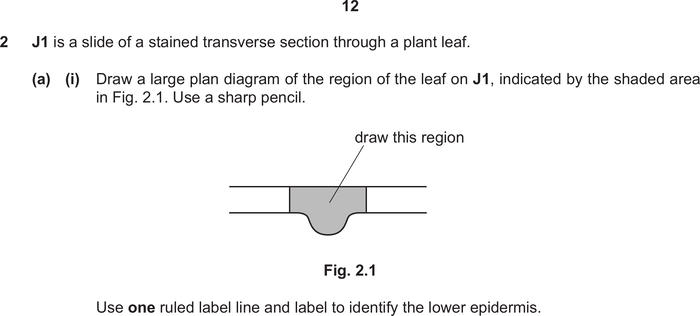
Mark scheme example: Plan diagram (Paper 3 — tissue drawing)

Plan diagram (Paper 3 — tissue drawing)

No individual cells. Show tissue boundaries with correct proportions. Epidermis = two parallel lines. Fill most of the space provided.

Common error: Drawing individual cells in a plan diagram. Incorrect proportions. Not filling the drawing space.

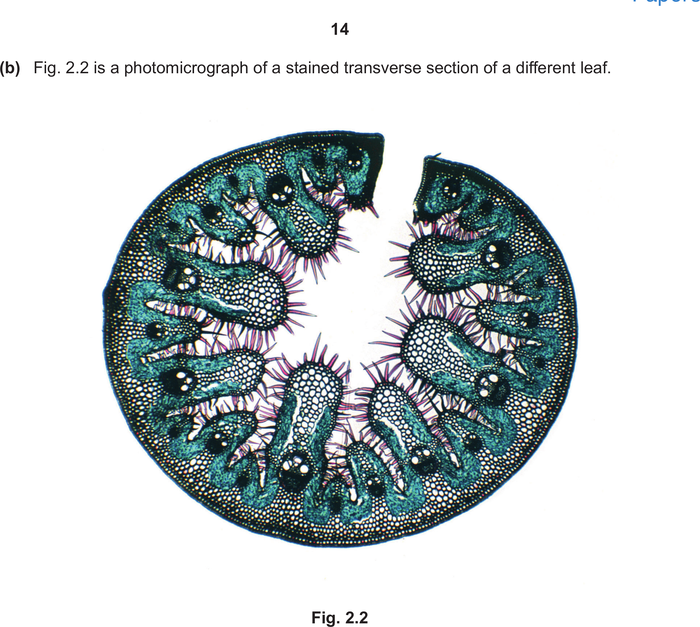
Mark scheme example: Cell drawing from micrograph (Paper 3)

Cell drawing from micrograph (Paper 3)

Sharp pencil, thin continuous lines. Double lines for cell walls. Draw what you SEE, not a textbook diagram. Label structures clearly.

Common error: Drawing textbook diagrams instead of what's visible in the micrograph. Broken lines. Not using double lines for cell walls.

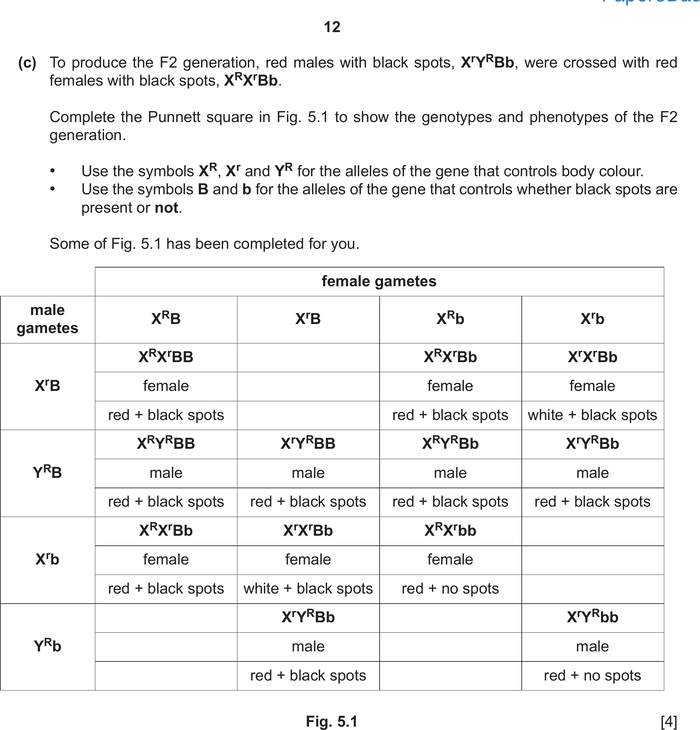
Mark scheme example: Punnett square (genetic crosses)

Punnett square (genetic crosses)

Show parental genotypes, gametes, and all offspring genotypes AND phenotypes. Use allele letters from the question.

Common error: Omitting phenotypes from the Punnett square. Not showing all 16 combinations in dihybrid crosses. Wrong allele letters.

⚠️

Topics Students Struggle With Most In AS & A Level Biology 9700

These AS & A Level Biology 9700 topics consistently produce the lowest scores. Prioritise these in your revision.

!

Protein structure — secondary vs tertiary vs quaternary

Hydrogen bonds in secondary structure (between backbone NH and CO groups) confused with those in tertiary structure (between R-groups). Collagen fibres vs collagen molecules repeatedly confused.

Affects: Paper 1, Paper 2

!

Respiration — locations, NAD, and oxidative phosphorylation

Glycolysis placed in mitochondria instead of cytoplasm. NAD called an 'electron carrier' instead of 'hydrogen atom carrier'. Matrix wrongly identified as site of oxidative phosphorylation.

Affects: Paper 4

!

Sources and sinks in phloem transport

'Many identified storage cells of seeds as sinks. This is true as seeds develop but when seeds start to grow (germinate), the storage cells become sources.' Leaves can be sinks for amino acids.

Affects: Paper 1, Paper 4

!

Phospholipid bilayer — counting membrane crossings

'Many thought a molecule of oxygen would pass through 5 or 6 phospholipid layers.' Each membrane = 2 phospholipid layers (bilayer). Students confuse membranes with layers.

Affects: Paper 1

!

Hardy-Weinberg equation application

q confused with q². p² + 2pq lumped together when calculating dominant phenotype. Heterozygote frequency (2pq) frequently halved incorrectly.

Affects: Paper 4

!

Meiosis stages — chromosome behaviour at each stage

Telophase II products: 'Few candidates recognised that telophase II results in four daughter cells.' Chromatids drawn joined at centromere after anaphase II (should be separated).

Affects: Paper 4

!

Immune system — T-cell differentiation and memory cells

'Many thought T-lymphocytes differentiate into T-helper and T-killer cells only at the time of immune response.' They differentiate during maturation in the thymus. Memory CELLS (not antibodies) provide long-lived immunity.

Affects: Paper 2, Paper 4

!

Genetic technology — restriction enzymes, recombinant DNA

'Most candidates had difficulty recalling knowledge from 19.1 Principles of genetic technology.' Restriction enzymes cut DNA (not mRNA). Role of ligase poorly known.

Affects: Paper 4

Target your weak areas

The topics above are where most marks are lost. Use past papers and mark schemes to practice these specific areas until they become second nature.

Frequently Asked Questions

What topics do students struggle with most in A Level Biology?

Protein structure (secondary vs tertiary), respiration locations and NAD, phloem sources/sinks, phospholipid layer counting, Hardy-Weinberg, meiosis stages, immune system details, and genetic technology.

What papers make up Cambridge A Level Biology 9700?

Paper 1 (MCQ, 40 marks), Paper 2 (AS structured, 60 marks), Paper 3 (practical, 40 marks), Paper 4 (A2 structured, 100 marks), Paper 5 (planning & analysis, 30 marks).

How many examiner reports were used for this guide?

4 official examiner reports and 2 mark schemes covering 2023–2025. Every insight is directly cited from these documents.

Methodology: Analysis of 4 official Cambridge examiner reports and 2 mark schemes (2023–2025). All examiner quotes are taken directly from official Cambridge Assessment International Education principal examiner reports. Question references correspond to specific past paper questions. This guide is updated when new examiner reports are released. Last updated: 2026-04-16.