Subject-specialist worked solutions — every mark explained. Topical & Yearly Solved, Revision Notes, Predicted Papers. Explore →

Exam Intelligence · 11 Official Documents Analysed

How to Score Higher in Cambridge AS & A Level Chemistry (9701)

Evidence-based Chemistry 9701 exam guide built from official examiner reports and mark schemes. Specialised and comprehensive study tips — specific, cited insights so you can achieve top grades.

Evidence-BasedBuilt from 11 official examiner reports & mark schemes (2023–2025)

What Are Assessment Objectives (AOs)?

Before we dive in, you need to understand how Cambridge actually marks your answers.

AO stands for Assessment Objective. Think of AOs as the different “skills” Cambridge tests you on in every single question. When an examiner marks your paper, they don't just give you a mark out of 12 based on how “good” your answer feels — they allocate specific marks to each AO separately.

For example, a 12-mark question might be split as: AO1 (2 marks) + AO2 (2 marks) + AO3 (2 marks) + AO4 (6 marks). If you write a perfect textbook answer but don't evaluate, you can only score 6 out of 12 — because the other 6 marks are specifically reserved for evaluation.

This is why understanding AOs matters: they tell you exactly what the examiner is looking for and how many marks each skill is worth. Here are the 3 AOs for this subject:

AO1

Knowledge and Understanding

40% of AS Level; 40% of A Level (50% of Papers 1, 2 and 4)

Demonstrate precise knowledge of definitions, formulae, mechanisms, structures, and chemical facts. Examiners reward word-perfect definitions — loose paraphrasing loses marks. Learn definitions verbatim: lattice energy, enthalpy of formation, ionisation energy, buffer solution, electronegativity, and coordination number are tested every session.

AO2

Handling, Applying and Evaluating Information

40% of AS Level; 40% of A Level (50% of Papers 1, 2 and 4)

Apply your knowledge to unfamiliar contexts, perform calculations correctly, draw accurate mechanisms, interpret data, and explain chemical phenomena. This includes balancing equations (atoms AND charge), drawing curly arrows with precision, using correct units, and carrying through multi-step calculations without premature rounding.

AO3

Experimental Skills and Investigations

20% of AS Level; 20% of A Level (100% of Paper 3; 100% of Paper 5)

Plan experiments and investigations; collect, record and present observations, measurements and estimates; analyse and interpret experimental data to reach conclusions; evaluate methods and experimental quality and suggest improvements. Assessed entirely through Paper 3 (Advanced Practical Skills) and Paper 5 (Planning, Analysis and Evaluation).

The key takeaway: Most students lose marks not because they lack knowledge (AO1), but because they skip the higher-order skills — building chains of reasoning (AO2) and making supported judgements (AO3). Everything below shows you exactly how to hit each AO based on what examiners have written in their reports.

🚫

Top Mistakes in AS & A Level Chemistry 9701

The most common reasons students lose marks in AS & A Level Chemistry 9701, cited directly from official examiner reports across multiple sessions.

1

Imprecise curly arrows in organic mechanisms

Criticised in every examiner report across all sessions (2021–2025) · Affects: Paper 2, Paper 4

What examiners say

A curly arrow should start clearly on a bond or on a lone pair and the arrowhead should point clearly in the direction of the destination of the electron pair.

Paper 4, May/June 2024

In electrophilic substitution, the first arrow should start on the circle within the hexagon. The second arrow should start in the middle of the C–H bond.

Paper 4, May/June 2024

How to fix this

Practice drawing mechanisms with a ruler. For EVERY curly arrow: (1) tail starts on a lone pair or the CENTRE of a bond, never on an atom; (2) head points to the exact atom or bond where the electron pair is going. In electrophilic substitution, the first arrow starts INSIDE the benzene ring circle. The intermediate's positive charge goes inside the partially delocalised ring, NOT on the sp³ carbon. The second arrow starts on the C–H BOND, not on the H atom.

2

Stating facts without explaining HOW or WHY

Flagged in every examiner report as a Key Message · Affects: Paper 2, Paper 4

What examiners say

Candidates are reminded to address 'explain' questions fully — not merely to state facts or rules of thumb, but then to show how these combine to give reasons for chemical phenomena.

Paper 2, March 2025

Candidates who gave the best answers were concise and precise. The accurate use of chemical vocabulary is crucial to answering certain questions.

Paper 2, May/June 2024

How to fix this

When a question says 'explain': State the fact THEN link it to the consequence. For example, don't just say 'nuclear charge increases' — say 'nuclear charge increases, so the attraction between the nucleus and the bonding electrons is stronger, which means more energy is needed to break the bond'. Build chains: Cause → Mechanism → Effect.

3

Imprecise or incomplete definitions

Mentioned in every session across Papers 2 and 4 · Affects: Paper 2, Paper 4

What examiners say

Most answers omitted that the elements were required to be in their 'standard states'.

Paper 2, May/June 2024

Commonly confused pairs

Lattice energy — must specify 'gaseous ions' and '1 mole of ionic compound'

Omitting '1 mole' with 'ionic compound formed' and starting from 1 mole of gaseous ions were common errors.

Paper 4, March 2025

Standard electrode potential vs. standard cell potential — two different definitions

A significant number of candidates referred to the standard hydrogen electrode and therefore gave the definition for standard electrode potential, not standard cell potential.

Paper 4, May/June 2021

How to fix this

Learn these definitions WORD-PERFECT: lattice energy, enthalpy of formation, enthalpy of neutralisation, ionisation energy, electronegativity, buffer solution, coordination number, standard cell potential. Write them out from memory and check against the syllabus. Every missing keyword (e.g. 'gaseous', 'standard states', '1 mole') costs a mark.

4

Using incorrect practical observation language

Flagged every session in Paper 3 and Paper 5 · Affects: Paper 3, Paper 5

What examiners say

'Gas released' is not credited in place of effervescence. 'No observation' is not the same as 'no visible change'. 'Clear' is not a colour.

Paper 3, March 2025

'Limewater turns milky' has not been accepted as a valid observation for several years. The correct observation is 'a white precipitate is formed'.

Paper 3, May/June 2024

How to fix this

Memorise these rules: (1) 'White precipitate' with limewater — NOT 'milky' or 'cloudy'. (2) 'Colourless' NOT 'clear' — clear means transparent, not a colour. (3) 'Effervescence' or 'bubbling' — NOT 'gas released'. (4) 'No visible change' — NOT 'no observation'. (5) A precipitate only forms when two solutions mix — adding a solid is NOT precipitate formation. (6) Always state the INITIAL colour before describing a colour change.

5

Premature rounding and significant figure errors in calculations

Every session, Papers 2, 3, 4, 5 · Affects: Paper 2, Paper 3, Paper 4, Paper 5

What examiners say

Harsh or early rounding of numbers should be avoided, as it leads to sizable inaccuracies later.

Paper 2, March 2025

How to fix this

Keep full calculator values until the FINAL answer. Give final answers to 3 significant figures unless told otherwise. Never give 1 sf. In multi-step calculations, show each step labelled (e.g. '[OH⁻] = 0.0158 mol dm⁻³') — examiners cannot award marks for unexplained numbers picked out of working.

6

Confusing SN1 and SN2 mechanisms for wrong substrate types

Flagged in 2021, 2022, 2023, 2024, 2025 sessions · Affects: Paper 2, Paper 4

What examiners say

1-bromobutane identified in the question is a primary halogenoalkane. Primary halogenoalkanes react with OH⁻ ions by the SN2 mechanism.

Paper 1, May/June 2024

Some answers confused the SN2 mechanism details with SN1.

Paper 2, May/June 2024

How to fix this

Simple rule: PRIMARY halogenoalkanes → SN2 (one-step, backside attack). TERTIARY halogenoalkanes → SN1 (two-step, carbocation intermediate). Secondary can go either way. In SN2, draw ONE transition state with partial bonds. In SN1, draw two steps with a carbocation intermediate. The carbocation stability explains why tertiary favours SN1.

7

Errors in q = mcΔT enthalpy calculations

Every practical session (Papers 3, 5) and calculation questions (Papers 2, 4) · Affects: Paper 3, Paper 4, Paper 5

What examiners say

Common errors were the use of the mass of the solid instead of the solution, and use of 4.2 for c instead of 4.18.

Paper 3, May/June 2024

How to fix this

Three rules: (1) Use the mass of the SOLUTION (usually water), NOT the mass of the solid being dissolved. (2) Use c = 4.18 J g⁻¹ K⁻¹ (not 4.2). (3) Do NOT add 273 to a temperature CHANGE — a change in °C equals a change in K. Also convert J to kJ (÷1000) and divide by moles for ΔH in kJ mol⁻¹.

8

Ambiguous or imprecise chemical language

Every session, all papers · Affects: Paper 2, Paper 3, Paper 4

What examiners say

'Surrounded by' is not a legitimate substitute for 'attached to' or 'bonded to'.

Paper 2, March 2025

How to fix this

Never use 'it' — always name the specific ion, molecule, or species. Avoid abbreviations (no 'IMFs', 'VdW', 'SE'). Use 'bonded to' not 'surrounded by'. Say 'delocalised electrons' not 'free electrons'. Say 'dissociation' not 'dissolution' for acids. Use 'more exothermic' or 'less exothermic' rather than 'increases' or 'decreases' for enthalpy values.

Apply what you've learned

Practice identifying these mistakes in real papers. Try a recent paper and mark yourself — you'll spot these patterns immediately.

What AS & A Level Chemistry 9701 Examiners Reward

Patterns that consistently earn high marks in AS & A Level Chemistry 9701, based on examiner report commentary on top-scoring answers.

Concise, precise answers that directly address the question

Examiners repeatedly state: 'The best answers are concise and precise: there is often little need for fully developed sentences, providing that the sense and balance of answers are clear.' Shorter, focused answers score higher than long, rambling ones that risk contradicting themselves.

Source: Paper 2, March 2025; Paper 2, March 2023

Showing full working in calculations with labelled intermediate values

Examiners award marks for correct method even when the final answer is wrong (error carried forward). Unexplained numbers cannot earn credit — always label what you're calculating, e.g. '[OH⁻] = 0.0158 mol dm⁻³'.

Source: Paper 4, May/June 2024

Using cause-and-effect chains in explanations

Top-scoring answers build logical chains: 'X happens → which causes Y → therefore Z'. One-sentence statements of fact earn only 1 mark; developed reasoning earns 2–3 marks on 'explain' questions.

Source: Paper 2, multiple sessions

Word-perfect definitions that match the syllabus exactly

Each definition has 2–3 marking points (M1, M2, M3). Missing one keyword ('gaseous', 'standard states', '1 mole') costs an entire mark. Candidates who memorise definitions verbatim gain an easy 15–20% of Paper 2 and Paper 4 marks.

Source: Paper 2 + Paper 4, all sessions

Drawing mechanisms with curly arrows starting and ending precisely

Mechanism marks are awarded per correct curly arrow and per correct intermediate. Arrows that start precisely on a lone pair or bond centre and point to the exact destination earn full marks even if surrounding working is imperfect.

Source: Paper 4, all sessions

Providing supporting evidence when claiming constant half-life or reaction order

Stating 'constant half-life' without data is not credited. Correct approach: 'The time taken to halve from 100% to 50% is 170 s, the time taken to halve from 50% to 25% is 160 s — these are approximately equal, confirming first order.'

Source: Paper 4, March 2025

📝

AS & A Level Chemistry 9701 Answer Frameworks

Structured approaches for each AS & A Level Chemistry 9701 question type, derived from mark scheme requirements.

Definition questions (1–2 marks)

30–60 seconds

Structure

Write the EXACT syllabus definition. Each key term earns a separate mark: M1 = core concept, M2 = qualifying condition (e.g. 'gaseous', 'standard states', '1 mole'). Do not paraphrase.

  • Learn these definitions verbatim: lattice energy, enthalpy of formation, enthalpy of neutralisation, first ionisation energy, electronegativity, buffer solution, standard cell potential, coordination number
  • Enthalpy of neutralisation = per mole of WATER formed, not per mole of acid
  • Lattice energy = from GASEOUS IONS to form 1 mole of IONIC COMPOUND
  • Atomisation = to produce ONE mole of GASEOUS atoms from the element in its STANDARD STATE

'Explain' questions (2–3 marks)

2–3 minutes

Structure

State → Reason → Consequence. M1: State the relevant chemical fact. M2: Give the reason using correct terminology. M3: Link to the outcome asked about in the question.

  • Never just state a rule — always explain WHY it leads to the observed effect
  • Use specific chemical vocabulary: 'electrostatic attraction', 'electron density', 'nuclear charge', not vague terms like 'stronger force'
  • Avoid the word 'it' — always name the specific species
  • If comparing two things, explicitly state both and explain the difference between them

Mechanism questions (2–4 marks)

3–5 minutes

Structure

Each curly arrow = 1 mark. Intermediate = 1 mark. Dipoles shown = 1 mark where required. Draw step-by-step with precise arrow placement.

  • Curly arrow tail: lone pair or middle of bond (NEVER on an atom)
  • Curly arrow head: to the specific atom or bond forming
  • Electrophilic substitution: first arrow from INSIDE the ring circle; positive charge on intermediate goes INSIDE the ring; second arrow from C–H BOND (not H atom)
  • Always show δ⁺/δ⁻ on polar bonds (e.g. C=O, C–Br) unless the question already shows them
  • Show H⁺ as a product leaving in the final step of electrophilic substitution

Calculation questions (2–4 marks)

3–5 minutes

Structure

Formula → Substitution → Answer with units. Label every intermediate value. Keep full calculator precision until the final step.

  • Show ALL working — error carried forward means you can still earn marks even if an early value is wrong
  • Label intermediate values: '[OH⁻] = 0.0158 mol dm⁻³' not just '0.0158'
  • Give final answers to 3 significant figures unless told otherwise
  • Include units with every final answer (mol dm⁻³, kJ mol⁻¹, s⁻¹, etc.)
  • Watch for unit traps: J vs kJ, cm³ vs dm³, °C change vs K (same value — do NOT add 273), s vs min in rate constants

Practical / Observation questions (Paper 3 & 5)

1–2 minutes per observation

Structure

State what you SEE (observation), not what you KNOW (deduction). Use approved terminology. Give initial AND final states for colour changes.

  • CO₂ test: 'forms a white precipitate with limewater' — NEVER 'turns milky'
  • 'Effervescence' or 'bubbling' — NOT 'gas given off'
  • 'Colourless' NOT 'clear' for solutions without colour
  • 'No visible change' NOT 'no observation'
  • Burette readings to 0.05 cm³ (end in .#0 or .#5), thermometer to 0.5°C
  • Concordant titres = within 0.10 cm³. Stop once concordance is achieved.

Practice by topic

Use topical past papers to practice specific question types. Each topic collects questions from multiple years — perfect for drilling the frameworks above.

💬

AS & A Level Chemistry 9701 Command Words Decoded

Each command word in AS & A Level Chemistry 9701 is a scoring instruction. Understanding what examiners expect is critical to earning full marks.

state1 mark

Give a brief factual answer — a term, name, value, or formula.

Common mistake

Writing a long explanation when only a word or phrase is needed.

define1–2 marks

Give the exact syllabus definition. Each keyword is a separate mark.

Common mistake

Paraphrasing loosely. Missing 'gaseous', 'standard states', or '1 mole' costs marks.

Candidates are advised to learn definitions precisely.

explain2–3 marks

State the fact AND show reasoning: cause → effect.

Common mistake

Stating a fact without showing HOW it leads to the conclusion.

Address 'explain' questions fully — not merely state facts, but show how these give reasons for chemical phenomena.

suggest1–2 marks

Apply knowledge to an unfamiliar situation. Reasoning must be sound.

Common mistake

Giving a textbook answer that doesn't fit the specific context.

deduce1–2 marks

Use the given data to reach a conclusion — not recalled from memory.

Common mistake

Ignoring the data and writing a memorised answer.

describe2–4 marks

Show every step with curly arrows, intermediates, and charges (mechanisms) or state what happens in order (processes).

Common mistake

Drawing arrows from atoms instead of from lone pairs or bond centres.

calculate2–3 marks

Show formula, substitution, and final answer with units (3 sf).

Common mistake

Not showing working — prevents error-carried-forward marks.

Examiners cannot award credit by picking unexplained numbers out of a response.

draw1–3 marks

Draw an accurate structure or diagram. Every detail matters.

Common mistake

Omitting lone pairs, partial charges, or using inconsistent wedge/dash notation.

📐

AS & A Level Chemistry 9701 Diagram Checklist

Incorrect diagrams in AS & A Level Chemistry 9701 are flagged in every examiner report. Use this checklist before every practice and in the exam.

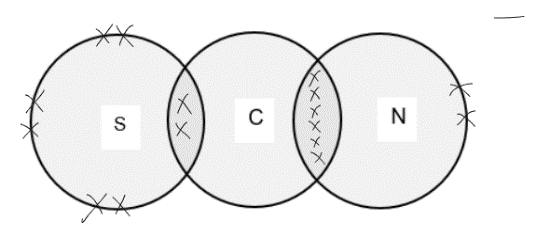
Mark scheme example: Dot-and-cross diagram (ionic compound)

Dot-and-cross diagram (ionic compound)

Show ALL electrons with dots and crosses. Show charge on each ion. Include square brackets around each ion.

Common error: Omitting lone pairs, not showing the charge on the ion, or showing incorrect number of electrons. For LiH, only four electrons total are required.

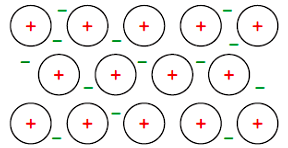
Mark scheme example: Metallic bonding diagram

Metallic bonding diagram

Rows of positive ions (labelled 'metal ions' or 'cations') surrounded by delocalised electrons (labelled).

Common error: Unlabelled drawings with just '+' signs. Positive symbols described as 'nuclei', 'protons', or 'atoms'. Electrons not labelled as 'delocalised'. Random placement of ions instead of ordered rows.

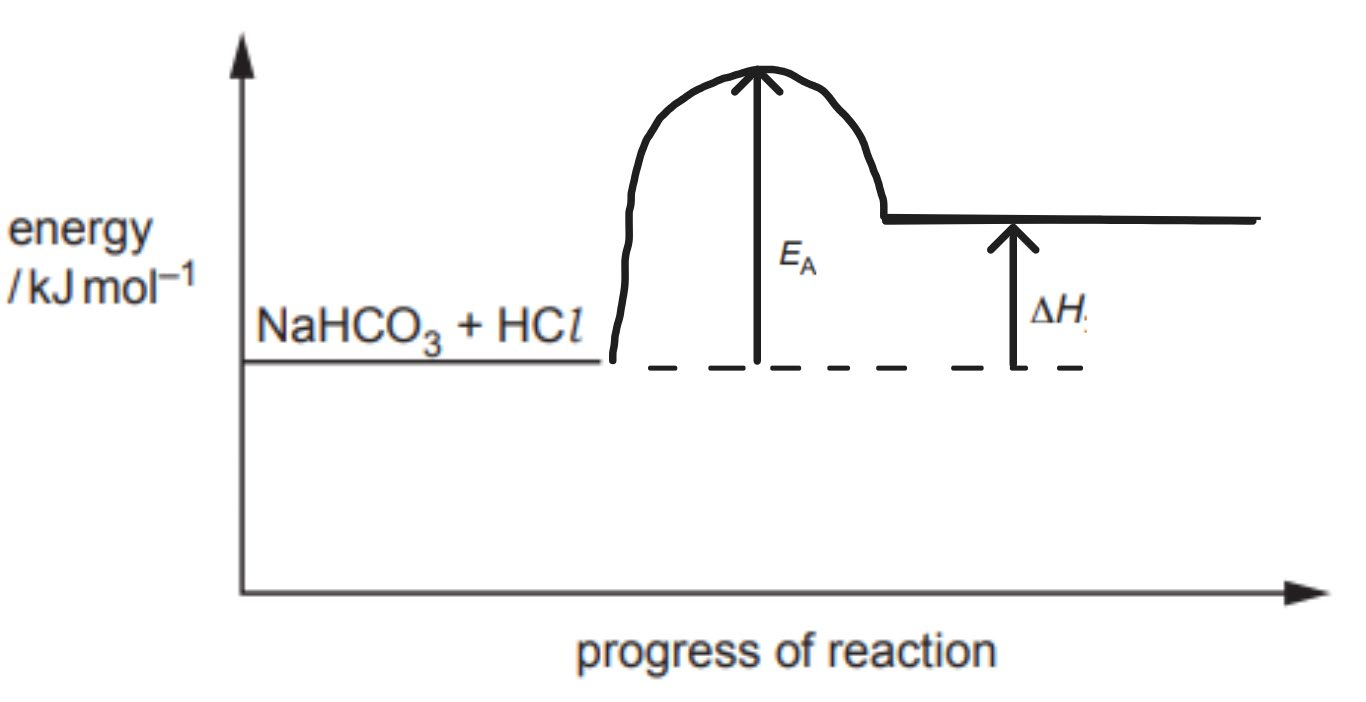
Mark scheme example: Enthalpy profile / reaction pathway

Enthalpy profile / reaction pathway

Axes: Progress of reaction × Enthalpy / Energy

Reactants at one level, products at another, with a 'hump' showing activation energy (Ea). Label ΔH and Ea clearly.

Common error: Confusing ΔH with Ea. Drawing endothermic profiles when the reaction is exothermic (and vice versa). Not clearly labelling both ΔH and Ea.

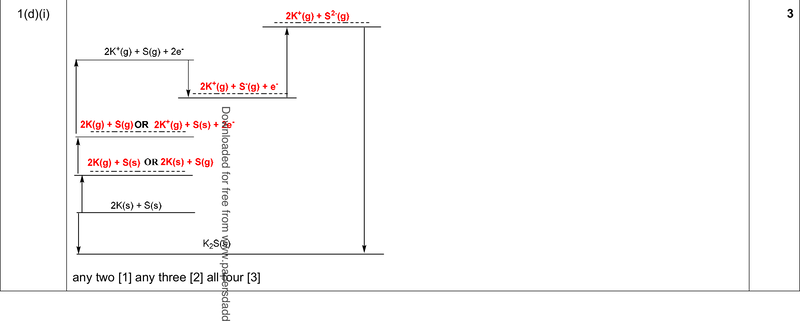
Mark scheme example: Born-Haber cycle

Born-Haber cycle

Step-by-step energy level diagram: elements → atomisation → ionisation → electron affinity → lattice energy → ionic compound.

Common error: Reversing the direction of electron affinity or lattice energy arrows. Confusing signs (exothermic = downward arrow). Not including ALL steps (atomisation of BOTH elements).

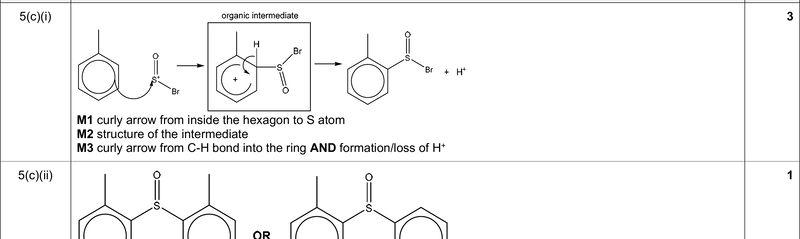
Mark scheme example: Electrophilic substitution mechanism

Electrophilic substitution mechanism

Arrow from inside the benzene ring to the electrophile. Intermediate with positive charge inside the partially delocalised ring. Arrow from C–H bond back into the ring, with H⁺ leaving.

Common error: Arrow not starting inside the ring circle. Positive charge placed on the sp³ carbon instead of inside the ring. Second arrow starting on H atom instead of the C–H bond. Omitting H⁺ as a product.

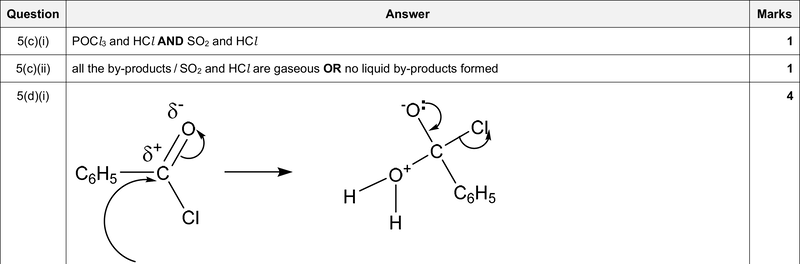
Mark scheme example: Nucleophilic addition-elimination mechanism

Nucleophilic addition-elimination mechanism

Arrow from lone pair on nucleophile to δ⁺ carbon of C=O. Intermediate with negative charge on oxygen. Arrow from C–O bond to reform C=O, arrow from C–Cl bond to Cl leaving.

Common error: Omitting the δ⁺/δ⁻ dipole on C=O. Arrow not starting from the lone pair on the nucleophile. In the intermediate, arrow going from O⁻ to C instead of from the C–O bond.

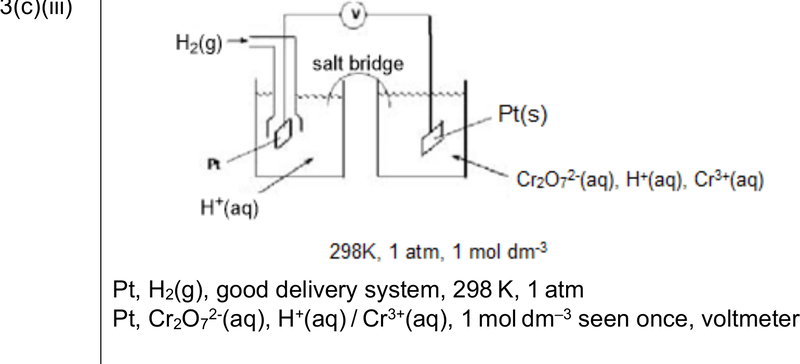
Mark scheme example: Electrochemical cell diagram

Electrochemical cell diagram

Two beakers with electrodes, connected by wire and salt bridge. Liquid level must touch both the electrode and the salt bridge in each beaker.

Common error: Using Sn electrode instead of Pt for Sn⁴⁺/Sn²⁺ half-cell. Including a cell/battery symbol (only use potentiometer). Not showing liquid level touching the salt bridge.

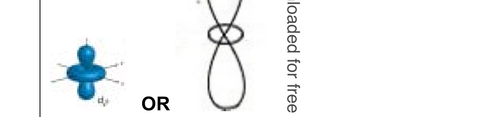
Mark scheme example: d-orbital shapes

d-orbital shapes

5 degenerate d-orbitals split into two groups: 3 lower (t₂g) and 2 upper (eg) for octahedral complexes. The dxy orbital has lobes BETWEEN the axes, not along them.

Common error: Drawing the dxy orbital lobes along the axes instead of between them. Not showing the energy of unsplit orbitals relative to the split ones.

⚠️

Topics Students Struggle With Most In AS & A Level Chemistry 9701

These AS & A Level Chemistry 9701 topics consistently produce the lowest scores. Prioritise these in your revision.

!

Electrophilic substitution mechanism

The single most poorly drawn mechanism across all sessions. Errors include: arrow not starting inside the ring, positive charge on sp³ carbon instead of inside the ring, second arrow starting on H instead of C–H bond, missing H⁺ product.

Affects: Paper 2, Paper 4

!

Nitrogen chemistry — basicity of amines and amides

Examiners report: 'The lack of basicity of an amide is due to the lone pair of electrons on the nitrogen atom being delocalised into the C=O group.' Also: 'attract a proton' is NOT equivalent to 'accept a proton' — the lone pair must FORM A COORDINATE BOND to a proton.

Affects: Paper 4

!

Period 3 reactions and properties (oxides and chlorides)

Candidates frequently mispredicted pH values: 'AlCl₃ was often omitted and considered to react with water to form a neutral solution.' NaCl is incorrectly described as acidic. SiCl₄ appearance at room temperature poorly known.

Affects: Paper 2

!

Lattice energy and Born-Haber cycles

Definition errors recur every session. Candidates confuse the direction of enthalpy arrows, use 'increases' instead of 'more exothermic', and make vague comparisons like 'BaSO₄ has greater attractions' without specifying which ions.

Affects: Paper 4

!

Kinetics — purpose of excess reagent and half-life evidence

Examiners: 'Many candidates did not understand that a large concentration was used to keep its concentration constant so that it did not affect the rate. A common error was to allow the reaction to go to completion.' Half-life claims without numerical evidence are not credited.

Affects: Paper 4

!

Buffer solutions — definition, pH calculation, and mechanism

Buffer definition must say 'resists changes in pH' not 'maintains constant pH'. At half-neutralisation, pH = pKa (because [acid] = [conjugate base]). Henderson-Hasselbalch errors include reversing acid and salt, and using wrong moles after acid/base addition.

Affects: Paper 4

!

Equilibrium — Le Chatelier's principle applied to novel situations

Candidates can state the principle but struggle to apply it to unfamiliar equilibria. Common errors: confusing 'amounts' with 'concentrations', ignoring physical states of reactants, and confusing equilibrium yield with rate.

Affects: Paper 2, Paper 4

!

Practical techniques — standard solution preparation and titration

Despite frequent testing, candidates struggle with: volumetric flask technique (stopper and invert to mix), when to rinse (beaker → flask = rinse; burette/pipette → flask = no rinse), and concordant titre selection (within 0.10 cm³).

Affects: Paper 3, Paper 5

!

Percentage error calculations

The uncertainty for instruments requiring TWO readings (balance, burette, thermometer) must be DOUBLED: e.g. burette = 2 × 0.05 cm³ = 0.10 cm³ total uncertainty. Balance = 2 × half-graduation. Few candidates apply this correctly.

Affects: Paper 3, Paper 5

Target your weak areas

The topics above are where most marks are lost. Use past papers and mark schemes to practice these specific areas until they become second nature.

Frequently Asked Questions

What is the most common reason students lose marks in A Level Chemistry?

Imprecise curly arrows in mechanisms and vague explanations that state facts without showing reasoning. Every examiner report (2021–2025) highlights these as the two biggest mark-losers.

How should I structure an 'explain' answer?

State → Reason → Consequence. State the chemical fact (M1), give the reason using precise vocabulary (M2), then link to the outcome asked about (M3). Never just quote a rule without showing how it applies.

Is 'limewater turns milky' still accepted for the CO₂ test?

No. Since 2022, only 'forms a white precipitate with limewater' is accepted. 'Milky', 'cloudy', and 'cloudy white' are no longer credited.

What papers make up Cambridge A Level Chemistry 9701?

Five papers: Paper 1 (MCQ, 40 marks), Paper 2 (AS structured, 60 marks), Paper 3 (practical, 40 marks), Paper 4 (A2 structured, 100 marks), and Paper 5 (planning & analysis, 30 marks).

How many examiner reports were used for this exam guide?

This guide is built from 10 official Cambridge examiner reports and 4 mark schemes spanning 2021–2025. Every insight is directly cited from these documents — no generic study tips.

Methodology: Analysis of 7 official Cambridge examiner reports and 4 mark schemes (2023–2025). All examiner quotes are taken directly from official Cambridge Assessment International Education principal examiner reports. Question references correspond to specific past paper questions. This guide is updated when new examiner reports are released. Last updated: 2026-04-10.