Subject-specialist worked solutions — every mark explained. Topical & Yearly Solved, Revision Notes, Predicted Papers. Explore →

Exam Intelligence · 7 Official Documents Analysed

How to Score Higher in Cambridge AS & A Level Mathematics (9709)

Evidence-based Mathematics 9709 exam guide built from official examiner reports and mark schemes. Specialised and comprehensive study tips — specific, cited insights so you can achieve top grades.

Evidence-BasedBuilt from 7 official examiner reports & mark schemes (2023–2025)

What Are Assessment Objectives (AOs)?

Before we dive in, you need to understand how Cambridge actually marks your answers.

AO stands for Assessment Objective. Think of AOs as the different “skills” Cambridge tests you on in every single question. When an examiner marks your paper, they don't just give you a mark out of 12 based on how “good” your answer feels — they allocate specific marks to each AO separately.

For example, a 12-mark question might be split as: AO1 (2 marks) + AO2 (2 marks) + AO3 (2 marks) + AO4 (6 marks). If you write a perfect textbook answer but don't evaluate, you can only score 6 out of 12 — because the other 6 marks are specifically reserved for evaluation.

This is why understanding AOs matters: they tell you exactly what the examiner is looking for and how many marks each skill is worth. Here are the 2 AOs for this subject:

AO1

Knowledge and Understanding

~55% of AS Level; ~52% of A Level (45–55% per paper)

Recall and use mathematical knowledge, formulae, and techniques. Know standard results (e.g. derivatives, integrals, trig identities) and apply them correctly. The formula booklet MF19 is provided — use it.

AO2

Application and Communication

~45% of AS Level; ~48% of A Level (45–55% per paper)

Apply maths to solve problems in structured and unstructured contexts. Show clear, logical working with correct notation. Communicate solutions so that each step follows from the last — examiners award method marks only when the method is visible.

The key takeaway: Most students lose marks not because they lack knowledge (AO1), but because they skip the higher-order skills — building chains of reasoning (AO2) and making supported judgements (AO3). Everything below shows you exactly how to hit each AO based on what examiners have written in their reports.

🚫

Top Mistakes in AS & A Level Mathematics 9709

The most common reasons students lose marks in AS & A Level Mathematics 9709, cited directly from official examiner reports across multiple sessions.

1

Writing only the answer from a calculator without showing working

Flagged in every Paper 1 and Paper 3 examiner report (2023–2025) · Affects: Paper 1, Paper 3

What examiners say

No marks will be given for unsupported answers from a calculator. For quadratic equations, it would be necessary to show factorisation, use of the quadratic formula or completing the square.

Paper 1, May/June 2023

Candidates are reminded that the rubric clearly states they must show all necessary working clearly; no marks will be given for unsupported answers from a calculator.

Paper 3, March 2025

How to fix this

For quadratics: show factorisation, the quadratic formula with values substituted, or completing the square. For definite integrals: show the limit substitution. For cubic factorisation: show polynomial division or factor theorem steps. The answer alone earns zero — the method IS the mark.

2

Incomplete working in 'show that' questions

Every session, Papers 1, 3, 4 · Affects: Paper 1, Paper 3, Paper 4

What examiners say

To gain full marks in a 'show that' question it is necessary for candidates to show each step clearly and to be accurate in their algebra.

Paper 1, March 2025

Candidates believed that the answer given should be used in the working to find the answer given, often resulting in candidates showing 0 = 0. The answer given should never be used in trying to obtain that result.

Paper 3, March 2023

How to fix this

In 'show that' questions: (1) Work TOWARDS the given answer, never FROM it. (2) Show every algebraic step — skipping lines loses marks. (3) If stuck, do NOT work backwards from the answer. (4) Confirm by stating the final result matches what was asked.

3

Premature rounding causing loss of accuracy marks

Every session, all papers · Affects: Paper 1, Paper 3, Paper 4, Paper 5, Paper 6

What examiners say

When working with decimal numbers, candidates need to work to at least 4 significant figures to ensure accuracy when they round their answer to 3 significant figures.

Paper 1, March 2025

Many candidates rounded prematurely in normal approximation questions, which caused them to identify incorrect values from the normal distribution tables.

Paper 5, March 2025

How to fix this

Keep at least 4 significant figures through all intermediate steps. Only round the FINAL answer to 3 sf. For exact answers (surds, fractions, pi), do not convert to decimals at all. In statistics, premature rounding of z-values leads to wrong probability areas.

4

Using SUVAT equations when acceleration is variable

Flagged in every Mechanics paper (2023–2025) · Affects: Paper 4

What examiners say

The most common error seen by examiners was for the use of constant acceleration formulas even though none of the particles were accelerating.

Paper 4, March 2025

A significant number of candidates incorrectly thought that the equations for constant acceleration could be used in this problem.

Paper 4, May/June 2023

How to fix this

SUVAT (s = ut + ½at², v = u + at, etc.) ONLY works when acceleration is constant. If the question gives acceleration as a function of time or displacement, you MUST use calculus: v = ∫a dt, s = ∫v dt. Check the question — if a is not a constant number, use calculus.

5

Not drawing force diagrams in Mechanics

Explicitly recommended in every Paper 4 report · Affects: Paper 4

What examiners say

A well annotated force diagram could help candidates to make sure that they include all relevant terms with correct signs when forming either an equilibrium situation or a Newton's Law equation.

Paper 4, March 2025

How to fix this

Before ANY mechanics calculation: draw a clear force diagram showing ALL forces (weight, normal reaction, tension, friction, driving force, air resistance). Label each force with its direction and magnitude. Resolve parallel and perpendicular to the direction of motion. This prevents missing terms and sign errors.

6

Misinterpreting probability success criteria ('at least', 'more than')

Every Paper 5 report · Affects: Paper 5

What examiners say

The interpretation of success criteria is an essential skill for this component.

Paper 5, March 2023

How to fix this

'At least 17' includes 17: P(X ≥ 17). 'More than 17' excludes 17: P(X > 17). 'Fewer than 17' excludes 17: P(X < 17). For 'at least one': use P(X ≥ 1) = 1 - P(X = 0). Always write out the inequality before calculating.

7

Hypothesis test conclusions without context or with definite language

Every Paper 6 report · Affects: Paper 6

What examiners say

Conclusions to hypothesis tests should be written in context and with a level of uncertainty in the language used. 'The mean time has decreased' would not be acceptable as it is a definite statement.

Paper 6, March 2025

How to fix this

Always write: 'There is sufficient evidence to suggest that [specific claim in context].' Never say 'The mean has decreased' (too definite). Never omit context (must reference what's being tested). Example: 'There is sufficient evidence to suggest that the mean journey time has decreased from 35 minutes.'

8

Argand diagram errors — wrong lines, scales, and regions

Every Paper 3 report · Affects: Paper 3

What examiners say

Few candidates scored more than a single mark, with the errors being wide ranging — wrong scales, wrong lines, wrong starting points, circles instead of half-lines.

Paper 3, March 2023

How to fix this

For Argand diagrams: (1) Use EQUAL scales on both axes. (2) |z - z₀| = r is a circle centre z₀ radius r. (3) arg(z - z₀) = α is a HALF-LINE starting from z₀ at angle α to the positive real direction. (4) |z - a| = |z - b| is the perpendicular bisector of the line joining a and b. Label everything.

Apply what you've learned

Practice identifying these mistakes in real papers. Try a recent paper and mark yourself — you'll spot these patterns immediately.

What AS & A Level Mathematics 9709 Examiners Reward

Patterns that consistently earn high marks in AS & A Level Mathematics 9709, based on examiner report commentary on top-scoring answers.

Showing every step of working, especially for 'show that' questions

Method marks (M marks) are awarded for visible valid methods. Unsupported answers from calculators earn zero. Even with a wrong final answer, clear working earns method marks via follow-through.

Source: All papers, 2023–2025

Drawing diagrams before starting — force diagrams, sketches, Argand diagrams

Examiners in Paper 4 explicitly recommend force diagrams. In Paper 1, 'very few diagrams were seen and a diagram might have helped them visualise a suitable method'. In Paper 5, 'simple sketches and diagrams can help to clarify both context and information.'

Source: Papers 1, 4, 5, multiple sessions

Keeping exact values throughout — fractions, surds, exact angles

In Mechanics: 'The angle was given exactly as sin⁻¹(1/√60). There is no need to evaluate the angle — approximation leads to loss of accuracy.' In Statistics: 'It is an inefficient use of time to convert an exact fractional value to an inexact decimal equivalent.'

Source: Paper 4, May/June 2023; Paper 5, March 2025

Using the formula booklet MF19 for standard results

Candidates who used the formula booklet for trig identities, series formulae, and standard integrals performed better. 'Very few completely correct responses were seen... even though the relevant identity is given in the List of Formulae MF19.'

Source: Paper 2/3, May/June 2023

Writing statistics conclusions in context with uncertain language

Hypothesis test conclusions earn marks only when they: (1) reference the specific context, (2) use phrases like 'sufficient evidence to suggest', and (3) avoid definite statements.

Source: Paper 6, 2023–2025

Applying multi-step transformations one at a time

'Candidates are encouraged to apply them one at a time.' Those who tried to combine transformations in one step made more errors.

Source: Paper 1, March 2025

📝

AS & A Level Mathematics 9709 Answer Frameworks

Structured approaches for each AS & A Level Mathematics 9709 question type, derived from mark scheme requirements.

'Show that' / Proof questions (2–4 marks)

3–5 minutes

Structure

Start from the left-hand side or given information → transform step by step → arrive at the printed result. Never work backwards.

  • Show EVERY algebraic step — skipping a line can lose the final mark
  • Never substitute the given answer into your working
  • If you get stuck, check for trig identities in MF19
  • End by writing the result that matches the question

Mechanics — Newton's second law questions (4–6 marks)

5–8 minutes

Structure

Draw force diagram → resolve forces → write F = ma equation → solve

  • Draw ALL forces first: weight, normal reaction, tension, friction, driving force
  • Choose a positive direction and stick to it
  • For connected particles: separate equation for each body, same acceleration
  • M1 is awarded for the correct number of terms — even with sign errors

Statistics — Normal distribution (3–5 marks)

4–6 minutes

Structure

Identify μ and σ → standardise using z = (x - μ)/σ → use tables → adjust probability area if needed

  • Draw a quick sketch of the normal curve and shade the required area
  • For normal approximation to binomial: apply continuity correction (±0.5)
  • Keep z-values to 4sf before looking up in tables
  • P(X > a) = 1 - P(X ≤ a) = 1 - Φ(z)

Complex numbers / Argand diagram (3–5 marks)

4–6 minutes

Structure

Identify the locus type → draw with correct centre/radius/angle → shade the correct region

  • |z - z₀| = r → circle, centre z₀, radius r
  • arg(z - z₀) = α → half-line from z₀ at angle α to positive real axis
  • |z - a| = |z - b| → perpendicular bisector of line joining a and b
  • Use EQUAL scales on both axes — unequal scales distort circles into ellipses

Integration questions (3–6 marks)

4–7 minutes

Structure

Identify the method → apply it showing every step → include constant of integration (indefinite) or substitute limits (definite)

  • For definite integrals: show the limit substitution explicitly — not just the answer
  • For integration by parts: if one application leaves an integral, apply parts again
  • Split fractions like (Bx + C)/(4 + x²) into Bx/(4 + x²) + C/(4 + x²) before integrating
  • Never forget +c for indefinite integrals — it's worth a mark

Practice by topic

Use topical past papers to practice specific question types. Each topic collects questions from multiple years — perfect for drilling the frameworks above.

💬

AS & A Level Mathematics 9709 Command Words Decoded

Each command word in AS & A Level Mathematics 9709 is a scoring instruction. Understanding what examiners expect is critical to earning full marks.

show that2–4 marks

Prove the given result, showing every algebraic step. The answer is printed — you must work towards it.

Common mistake

Working backwards from the given answer, or skipping steps. Never use the given result in your proof.

state1 mark

Write the answer immediately — no working needed.

Common mistake

Doing unnecessary working when the answer should be obvious from the question.

find2–5 marks

Calculate the answer, showing your method clearly.

Common mistake

Writing only the final answer without showing method — calculator answers earn zero.

sketch2–3 marks

Draw the general shape showing key features (intercepts, asymptotes, turning points). Not a precise plot.

Common mistake

Drawing a table of values and plotting points. A sketch shows shape and key features — don't waste time on accuracy.

henceVariable

Use the result you just proved/found. Do NOT start from scratch.

Common mistake

Ignoring the previous result and using a completely different method. 'Hence' means your answer MUST follow from the previous part.

deduce1–2 marks

Draw a conclusion from the given information or your previous answer.

Common mistake

Restarting the problem instead of using the result you already have.

📐

AS & A Level Mathematics 9709 Diagram Checklist

Incorrect diagrams in AS & A Level Mathematics 9709 are flagged in every examiner report. Use this checklist before every practice and in the exam.

Mark scheme example: Force diagram (Mechanics)

Force diagram (Mechanics)

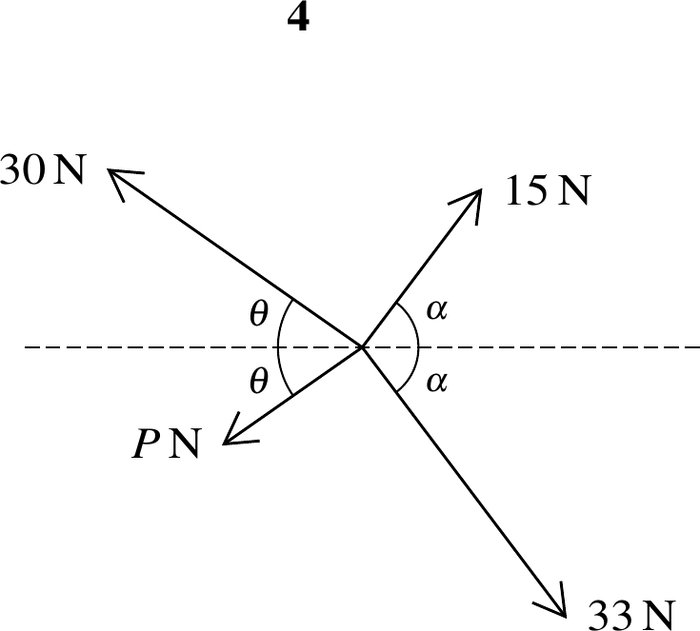
Show ALL forces acting on the body: weight (mg downward), normal reaction (perpendicular to surface), tension, friction (opposing motion), driving force. Label magnitudes and directions.

Common error: Missing forces (especially friction or normal reaction). Not resolving on inclined planes. Confusing tension with thrust.

Mark scheme example: Argand diagram (Complex numbers)

Argand diagram (Complex numbers)

Axes: Real axis (Re) × Imaginary axis (Im)

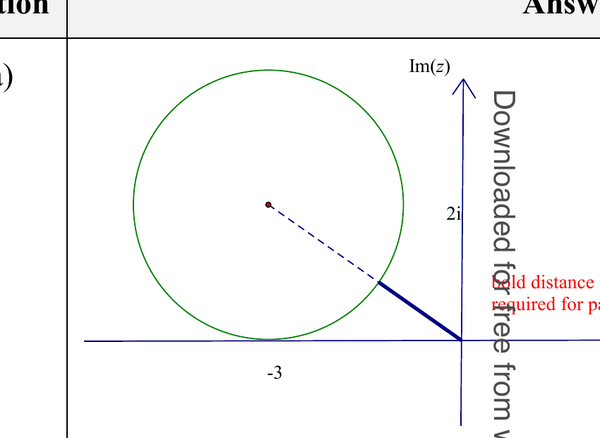
Circles for |z - z₀| = r. Half-lines for arg(z - z₀) = α. Perpendicular bisectors for |z - a| = |z - b|. Shade the correct region.

Common error: Unequal scales on real and imaginary axes. Drawing full lines instead of half-lines for arg. Starting half-lines from the origin instead of from z₀.

Mark scheme example: Normal distribution sketch

Normal distribution sketch

Axes: Value of X × Probability density

Bell curve centred on μ. Mark the value(s) of interest on the x-axis. Shade the area that represents the required probability.

Common error: Not marking μ on the x-axis. Shading the wrong tail. Forgetting to shade both tails for two-tailed tests.

Mark scheme example: Graph sketching (Pure Maths)

Graph sketching (Pure Maths)

Axes: x × y

Show: correct general shape, x-intercepts, y-intercept, asymptotes (if any), turning points. Label key coordinates.

Common error: Plotting points from a table instead of sketching shape. Not showing asymptotic behaviour. Missing turning points or intercepts.

⚠️

Topics Students Struggle With Most In AS & A Level Mathematics 9709

These AS & A Level Mathematics 9709 topics consistently produce the lowest scores. Prioritise these in your revision.

!

Argand diagrams and complex number loci

Repeatedly the weakest area on Paper 3. Few candidates score more than 1 mark. Half-lines vs full lines, starting points, equal scales, and region shading are all common errors.

Affects: Paper 3

!

Work-energy principle and variable forces

Most challenging topic on Paper 4. Candidates confuse force with work done, omit PE terms, use (v - u)² instead of (v² - u²) for KE change, and apply SUVAT when acceleration is variable.

Affects: Paper 4

!

Permutations with restrictions (letters not adjacent, groups)

Consistently challenging on Paper 5. Common error: not dividing by repeated items, or not considering arrangements within groups.

Affects: Paper 5

!

Integration techniques — partial fractions, substitution, by parts

On Paper 3, candidates struggle with: wrong partial fraction form (missing Bx+C for irreducible quadratics), not splitting rational fractions before integrating, and not recognising when a second application of parts is needed.

Affects: Paper 3

!

Rates of change and chain rule applications

On Paper 1: 'The majority of candidates did not appreciate that this question about rates of change required differentiation so could be awarded no marks.'

Affects: Paper 1

!

Normal approximation to binomial with continuity correction

On Paper 5, many candidates either omit the continuity correction, apply it in the wrong direction, or apply it to continuous data where it's not needed.

Affects: Paper 5

!

Hypothesis test conclusions (Paper 6)

Conclusions must be in context with uncertain language. 'The mean time has decreased' earns zero. Must say 'There is sufficient evidence to suggest that the mean journey time has decreased.'

Affects: Paper 6

!

Volume of revolution about the y-axis

On Paper 1: 'the question clearly stated rotation about the y-axis, but a significant number did not take this into account.' Others forgot to square the function before integrating.

Affects: Paper 1

Target your weak areas

The topics above are where most marks are lost. Use past papers and mark schemes to practice these specific areas until they become second nature.

Frequently Asked Questions

What are the most common topics students struggle with in A Level Maths?

Argand diagrams and complex number loci (Paper 3), work-energy principle with variable forces (Paper 4), permutations with restrictions (Paper 5), and integration techniques like partial fractions and substitution (Paper 3).

What papers make up Cambridge A Level Mathematics 9709?

Paper 1: Pure Maths 1 (75 marks, AS). Paper 3: Pure Maths 3 (75 marks, A2). Paper 4: Mechanics (50 marks). Paper 5: Probability & Statistics 1 (50 marks). Paper 6: Probability & Statistics 2 (50 marks, A2). Route depends on your combination.

How should I handle 'show that' questions?

Work towards the printed answer showing every step. Never substitute the given answer into your working. If you get stuck, review your algebra rather than trying to reverse-engineer the result.

Do I need to draw diagrams in Mechanics?

Yes. Every examiner report recommends force diagrams. They help you identify all forces, choose signs correctly, and avoid missing terms. A clear force diagram often earns an implicit method mark.

How many examiner reports were used for this guide?

This guide is built from 3 official examiner reports and 4 mark schemes covering 2023–2025. Every insight is directly cited from these documents.

Put It All Into Practice

You now know exactly what examiners reward and penalise. The next step is deliberate practice with real papers. We have 58 exam sessions available for AS & A Level Mathematics 9709 — question papers, mark schemes, and examiner reports.

Methodology: Analysis of 3 official Cambridge examiner reports and 4 mark schemes (2023–2025). All examiner quotes are taken directly from official Cambridge Assessment International Education principal examiner reports. Question references correspond to specific past paper questions. This guide is updated when new examiner reports are released. Last updated: 2026-04-16.