Subject-specialist worked solutions — every mark explained. Topical & Yearly Solved, Revision Notes, Predicted Papers. Explore →

Exam Intelligence · 5 Official Documents Analysed

How to Score Higher in Cambridge AS & A Level Physics (9702)

Evidence-based Physics 9702 exam guide built from official examiner reports and mark schemes. Specialised and comprehensive study tips — specific, cited insights so you can achieve top grades.

Evidence-BasedBuilt from 5 official examiner reports & mark schemes (2023–2025)

What Are Assessment Objectives (AOs)?

Before we dive in, you need to understand how Cambridge actually marks your answers.

AO stands for Assessment Objective. Think of AOs as the different “skills” Cambridge tests you on in every single question. When an examiner marks your paper, they don't just give you a mark out of 12 based on how “good” your answer feels — they allocate specific marks to each AO separately.

For example, a 12-mark question might be split as: AO1 (2 marks) + AO2 (2 marks) + AO3 (2 marks) + AO4 (6 marks). If you write a perfect textbook answer but don't evaluate, you can only score 6 out of 12 — because the other 6 marks are specifically reserved for evaluation.

This is why understanding AOs matters: they tell you exactly what the examiner is looking for and how many marks each skill is worth. Here are the 3 AOs for this subject:

AO1

Knowledge and Understanding

40% of AS Level; 40% of A Level (50% of Papers 1, 2 and 4)

Recall and demonstrate understanding of physics facts, definitions, formulae, and concepts. Definitions must include every key word — omitting 'per unit mass' or 'resultant' or 'moving' loses marks.

AO2

Handling, Applying and Evaluating Information

40% of AS Level; 40% of A Level (50% of Papers 1, 2 and 4)

Apply physics to solve problems, interpret data, perform calculations, and evaluate experimental methods. Always state the equation first, then substitute values. Show every unit conversion explicitly.

AO3

Experimental Skills and Investigations

20% of AS Level; 20% of A Level (100% of Paper 3; 100% of Paper 5)

Plan experiments and investigations; collect, record and present observations, measurements and estimates; analyse and interpret experimental data to reach conclusions; evaluate methods and quality of experimental data and suggest improvements. Assessed entirely through Paper 3 (Advanced Practical Skills) and Paper 5 (Planning, Analysis and Evaluation).

The key takeaway: Most students lose marks not because they lack knowledge (AO1), but because they skip the higher-order skills — building chains of reasoning (AO2) and making supported judgements (AO3). Everything below shows you exactly how to hit each AO based on what examiners have written in their reports.

🚫

Top Mistakes in AS & A Level Physics 9702

The most common reasons students lose marks in AS & A Level Physics 9702, cited directly from official examiner reports across multiple sessions.

1

Unit conversion errors — powers of ten wrong when converting cm, mm, km

The single most repeated error across all papers and sessions (2023–2025) · Affects: Paper 1, Paper 2, Paper 4

What examiners say

There was a significant number of candidates that made errors converting the mass in grams into kilograms and the length from centimetres into metres.

Paper 2, March 2025

Those selecting D made a power-of-ten error when converting mm² into m².

Paper 1, May/June 2023

How to fix this

Write every conversion explicitly: 1 cm = 10⁻² m, 1 mm = 10⁻³ m, 1 km = 10³ m. For AREA: cm² to m² = ×10⁻⁴ (not ×10⁻²). For VOLUME: cm³ to m³ = ×10⁻⁶. Always write the conversion as a separate line in your working.

2

Missing key words in definitions — 'resultant', 'per unit', 'moving'

Every Paper 2 and Paper 4 report · Affects: Paper 2, Paper 4

What examiners say

A significant number gave 'mass times acceleration' which is a valid way to calculate force, but is not the definition of force required by the syllabus.

Paper 2, March 2025

The definition of de Broglie wavelength is given in the syllabus. Many candidates quoted this correctly but the word 'moving' was frequently missing.

Paper 4, May/June 2023

How to fix this

Learn definitions EXACTLY: Force = rate of change of momentum (NOT mass × acceleration). Gravitational field = force PER UNIT MASS. Electric field = force per unit POSITIVE charge. Equilibrium = RESULTANT force is zero AND RESULTANT torque is zero. Half-life = time for ACTIVITY to halve (not 'number of nuclei').

3

Swapping sine and cosine when resolving vectors

Every session, Paper 1 and Paper 2 · Affects: Paper 1, Paper 2

What examiners say

Candidates had particular difficulty resolving vectors into perpendicular components. Candidates should be able to select the correct trigonometric function for each problem.

Paper 1, March 2025

Weaker candidates selected option B most frequently, which is the result of swapping sine and cosine when resolving the force in the wire.

Paper 1, March 2025

How to fix this

Draw a right-angle triangle. The component ADJACENT to the angle uses cosine. The component OPPOSITE to the angle uses sine. If the angle is measured from the horizontal: horizontal = F cos θ, vertical = F sin θ. Always sketch the triangle — don't guess.

4

Using ½m(v−u)² instead of ½mv²−½mu² for kinetic energy change

Multiple sessions, Papers 1 and 2 · Affects: Paper 1, Paper 2

What examiners say

A common mistake was to calculate the gain in kinetic energy by using the expression ½m(v − u)².

Paper 2, March 2025

How to fix this

Change in KE = ½mv² − ½mu² (subtract the kinetic energies). NOT ½m(v − u)² — that's squaring the velocity difference, which is mathematically wrong. Remember: KE depends on v², and (v² − u²) ≠ (v − u)².

5

Confusing number density with total number of charge carriers

Every session where I = nAvq is tested · Affects: Paper 2

What examiners say

The most common mistake was to substitute the total number of charge carriers instead of the number density of charge carriers.

Paper 2, March 2025

Many candidates confused the total number of free electrons in the wire with the number density of the free electrons.

Paper 2, May/June 2023

How to fix this

In I = nAvq: n is NUMBER DENSITY (number per unit volume, in m⁻³), NOT the total number. If given total number N and volume V, then n = N/V. If given total number and dimensions, calculate volume first, then divide.

6

Confusing stationary waves with two-source interference

Every session, Paper 2 · Affects: Paper 2

What examiners say

Many candidates seemed to confuse the production of a stationary wave with the production of a two-source interference pattern. Many incorrectly referred to maximum displacement instead of maximum amplitude at antinodes.

Paper 2, March 2025

How to fix this

Stationary waves: formed by superposition of two waves travelling in OPPOSITE directions (same frequency, same amplitude). The distance between a node and adjacent antinode = λ/4 (not λ/2). At antinodes, the AMPLITUDE is maximum (not displacement — displacement oscillates). For two-source interference: waves travel in the SAME direction from two coherent sources.

7

Uncertainty propagation errors — not multiplying percentage uncertainty by powers

Every session, Papers 2, 3, 5 · Affects: Paper 2, Paper 3, Paper 5

What examiners say

Many did not recognise the need to multiply the percentage uncertainty in the volume by three. Some incorrectly multiplied the percentage uncertainty in mass by three.

Paper 2, March 2025

How to fix this

If a quantity is raised to a power: multiply the percentage uncertainty by that power. Volume = length³, so %uncertainty in V = 3 × %uncertainty in length. Speed = distance/time, so %uncertainty in speed = %uncertainty in distance + %uncertainty in time. For ½mv², %uncertainty in KE = %uncertainty in m + 2 × %uncertainty in v.

8

Resistance from V-I graph — using gradient instead of V/I ratio

Papers 1 and 2 · Affects: Paper 1, Paper 2

What examiners say

A common misconception was that the resistance was constant because the gradient of the graph line was constant. Candidates need to be aware that the resistance is given by the ratio of the potential difference to the current and is not given by the gradient of the graph line.

Paper 2, March 2023

How to fix this

Resistance = V/I (the ratio at a point), NOT the gradient of the V-I graph. A straight line through the origin means constant resistance. A curve means changing resistance — read V and I at each point and divide. At zero current, resistance is infinite (not zero).

Apply what you've learned

Practice identifying these mistakes in real papers. Try a recent paper and mark yourself — you'll spot these patterns immediately.

What AS & A Level Physics 9702 Examiners Reward

Patterns that consistently earn high marks in AS & A Level Physics 9702, based on examiner report commentary on top-scoring answers.

State the equation first, then substitute values

'In some questions marks can be scored for correct statements of physical equations, but only where the whole equation is clearly shown.' Writing the equation earns method marks even if the final answer is wrong.

Source: Paper 2, March 2025

Show every unit conversion as a separate step

Unit conversion is the #1 error. Candidates who write '85 km h⁻¹ = 85/3.6 = 23.6 m s⁻¹' as a visible step avoid power-of-ten errors that lose marks.

Source: Paper 1, March 2025

Learn definitions with every key word

'A significant number of marks may be obtained by candidates who are able to demonstrate accurate recall. The omission of one or two key words from a definition may prevent credit from being awarded.'

Source: Paper 2, May/June 2023

Calculate MCQ answers before looking at options

'It is a good idea to try to calculate the answer before looking at the answer options. All four options should be considered carefully.' This prevents being tricked by common-error distractors.

Source: Paper 1, all sessions

Use 'per unit' phrasing for ratio definitions

'This often requires use of the phrase per unit where the quantity being defined is the ratio between two other quantities.' Gravitational field = force per unit mass, not just force on mass.

Source: Paper 4, May/June 2023

Avoid ambiguous pronouns — name the specific object

'Candidates should be encouraged to avoid using the pronoun it in a sentence when the meaning of it is vague or ambiguous.' Say 'the block accelerates' not 'it accelerates'.

Source: Paper 2, March 2023

📝

AS & A Level Physics 9702 Answer Frameworks

Structured approaches for each AS & A Level Physics 9702 question type, derived from mark scheme requirements.

Definition questions (1–2 marks)

30 seconds

Structure

Write the exact syllabus definition. Every key word is a mark point.

  • Force = rate of change of MOMENTUM (not mass × acceleration)
  • Gravitational field = force PER UNIT MASS
  • Equilibrium = RESULTANT force zero AND RESULTANT torque zero
  • Half-life = time for ACTIVITY to halve
  • Mass defect = difference between mass of nucleons and mass of nucleus

Calculation questions (2–5 marks)

3–6 minutes

Structure

State equation → convert units → substitute → solve → answer with units to correct sf

  • Write the equation in symbols FIRST — this earns a method mark
  • Show unit conversions as a visible step (e.g. 85 km h⁻¹ = 23.6 m s⁻¹)
  • Keep 4+ sf for intermediates, give final answer to match data (usually 2–3 sf)
  • Include units in the final answer — missing units can lose the answer mark

Vector resolution questions (2–3 marks)

2–3 minutes

Structure

Draw the triangle → identify adjacent/opposite → apply sin/cos → state direction

  • Adjacent to θ → cosine. Opposite to θ → sine. Draw the triangle every time.
  • Momentum is a VECTOR — change in momentum requires vector subtraction
  • Always state the direction of your final answer for vector quantities

Paper 3/5 — Experimental skills (variable marks)

Variable

Structure

Record to full resolution → plot with crosses → large gradient triangle → specific limitations

  • Ruler readings to nearest mm. Stopwatch to 0.01s. Protractor to 1°.
  • Graph: gradient triangle hypotenuse > half the line length
  • Limitation must be SPECIFIC: 'difficult to judge when oscillation is complete' not 'difficult to measure time'
  • 'Repeat and average' is standard practice — not a valid improvement

Practice by topic

Use topical past papers to practice specific question types. Each topic collects questions from multiple years — perfect for drilling the frameworks above.

💬

AS & A Level Physics 9702 Command Words Decoded

Each command word in AS & A Level Physics 9702 is a scoring instruction. Understanding what examiners expect is critical to earning full marks.

define1–2 marks

Give the precise syllabus definition with every key word.

Common mistake

Giving a method of calculation (F = ma) instead of the definition (rate of change of momentum).

state1 mark

Give a brief factual answer. No working needed.

Common mistake

Writing an explanation when only a value or term is required.

show that2–4 marks

Prove the given result. Show every step, including unit conversions.

Common mistake

Fudging intermediate values to reach the printed answer. All working must be correct throughout.

state and explain2–3 marks

Give the answer AND the physics reasoning. Both are required.

Common mistake

Only stating without explaining, or only explaining without a clear final statement.

describe1–2 marks

State what happens. Do not explain why.

Common mistake

Giving an explanation (reasons) when only a description (observations) is asked for.

determine2–4 marks

Find the value by calculation or from data. Show method.

Common mistake

Not showing the equation used. Unsupported final answers earn zero.

📐

AS & A Level Physics 9702 Diagram Checklist

Incorrect diagrams in AS & A Level Physics 9702 are flagged in every examiner report. Use this checklist before every practice and in the exam.

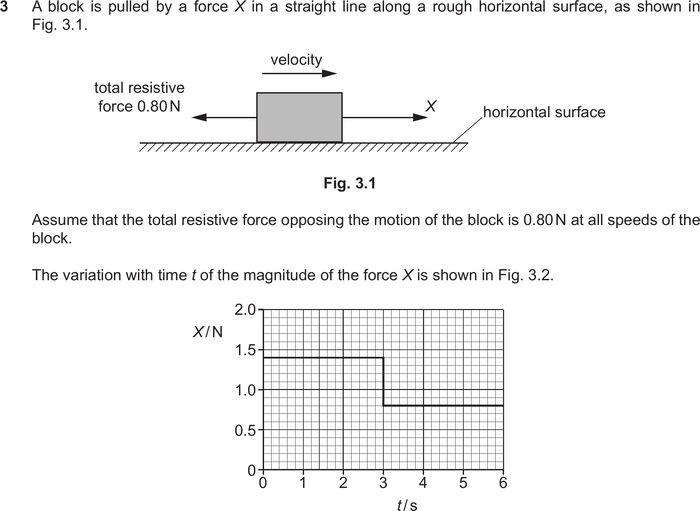
Mark scheme example: Force diagram (block on surface with forces)

Force diagram (block on surface with forces)

Show ALL forces: weight (mg down), normal reaction (perpendicular to surface), applied force (direction given), friction (opposing motion). Label each with magnitude and direction.

Common error: Missing friction or normal reaction. Drawing forces at wrong angles. Not resolving on inclined planes.

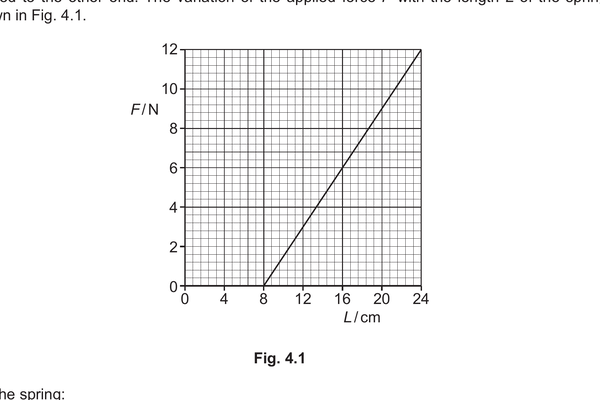
Mark scheme example: Force-extension graph (Hooke's law)

Force-extension graph (Hooke's law)

Axes: Extension / cm (or m) × Force / N

Straight line through origin up to the limit of proportionality, then curves. Gradient = spring constant k.

Common error: Using length instead of extension on x-axis. Not identifying where the line departs from straight (elastic limit).

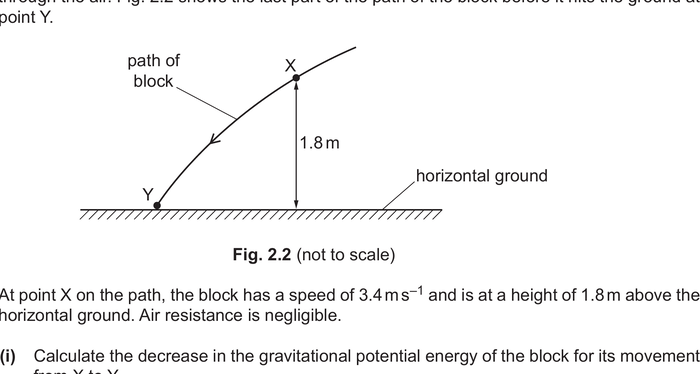
Mark scheme example: Projectile motion path

Projectile motion path

Axes: Horizontal distance × Height

Parabolic path. Horizontal velocity constant (no air resistance). Vertical velocity increases downward. Speed at any point = √(vx² + vy²).

Common error: Thinking KE = 0 at highest point (horizontal velocity still exists). Using ½m(v−u)² for KE change instead of ½mv²−½mu².

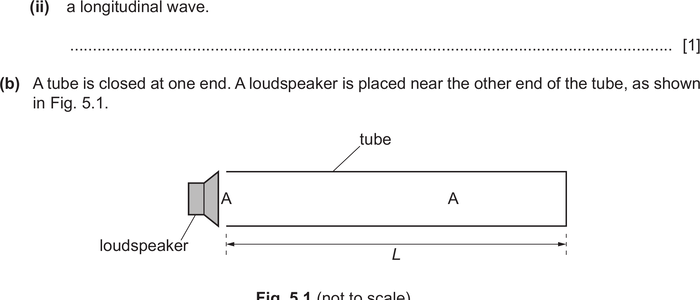
Mark scheme example: Stationary wave in closed tube

Stationary wave in closed tube

Node at closed end. Antinode at open end. Distance from node to adjacent antinode = λ/4. Mark positions of nodes (N) and antinodes (A).

Common error: Saying node-to-antinode distance = λ/2 (it's λ/4). Confusing stationary wave formation with two-source interference.

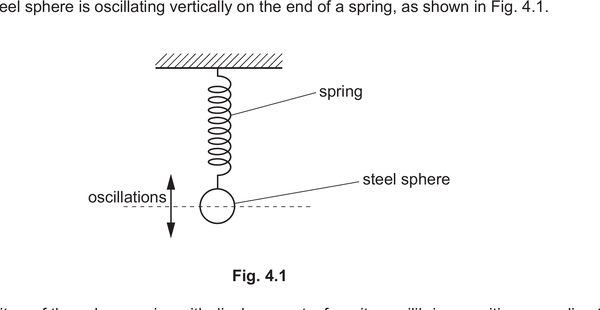
Mark scheme example: SHM spring-mass system

SHM spring-mass system

Mass on spring oscillating vertically. Displacement x from equilibrium position. a = −ω²x (acceleration always directed towards equilibrium).

Common error: Using SUVAT equations for SHM (acceleration is not constant). Confusing amplitude with displacement.

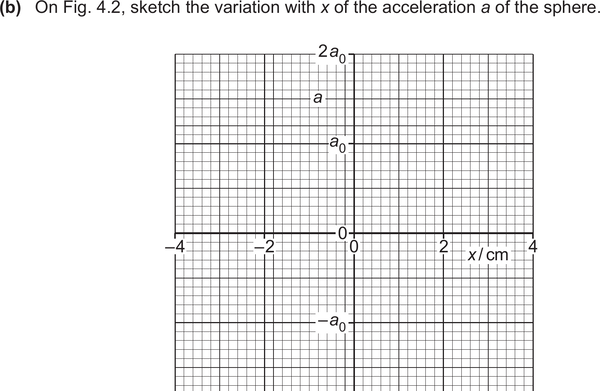
Mark scheme example: SHM acceleration vs displacement graph

SHM acceleration vs displacement graph

Axes: Displacement x / cm × Acceleration a / cm s⁻²

Straight line through origin with NEGATIVE gradient. a = −ω²x. At x = 0, a = 0. At x = max (amplitude), a = max.

Common error: Drawing a positive gradient (acceleration should be opposite to displacement). Drawing a curve instead of a straight line.

⚠️

Topics Students Struggle With Most In AS & A Level Physics 9702

These AS & A Level Physics 9702 topics consistently produce the lowest scores. Prioritise these in your revision.

!

Unit conversions — cm² to m², mm to m, km h⁻¹ to m s⁻¹

The single most common error across all papers. 'Candidates frequently made a power-of-ten error when converting cm³ into m³.' Area and volume conversions are worst.

Affects: Paper 1, Paper 2

!

Projectile motion — 2D velocity and KE at highest point

'All 4 options selected roughly equally indicating that the variation of speed in two dimensions without air resistance is not well understood by most candidates.'

Affects: Paper 1

!

Stationary waves vs interference — node/antinode spacing

'A common misconception was that the distance between P and Q was equal to half a wavelength' when it should be a quarter wavelength (node to antinode).

Affects: Paper 2

!

Potential divider circuits

'Many candidates found it difficult to apply their understanding to an electric circuit. The relationship between the potential difference across each resistor and its value of resistance was not well understood.'

Affects: Paper 2

!

Internal resistance and terminal p.d.

'Candidates found this question challenging, with many confusing the concept of terminal p.d. and e.m.f.' Terminal p.d. = E − Ir, which decreases as current increases.

Affects: Paper 1, Paper 2

!

First law of thermodynamics — application to cycles

'Only the strongest candidates appreciated that the work done by the gas in stage CD is greater than the work done on the gas in stage AB.' Confusion between internal energy and change in internal energy.

Affects: Paper 4

!

Gravitational/electric field definitions

'Only a minority of candidates knew that gravitational field is defined as force per unit mass.' The phrase 'per unit' is essential for all field definitions.

Affects: Paper 4

!

Electromagnetic spectrum — typical wavelengths

'Fewer than half of candidates could recall the approximate wavelength of infrared radiation.' Factual recall of wavelength ranges is a syllabus requirement.

Affects: Paper 1

Target your weak areas

The topics above are where most marks are lost. Use past papers and mark schemes to practice these specific areas until they become second nature.

Frequently Asked Questions

What is the most common error in A Level Physics?

Unit conversion — powers of ten wrong when converting cm to m, mm² to m², km h⁻¹ to m s⁻¹. This is flagged in every single examiner report across all papers.

What papers make up Cambridge A Level Physics 9702?

Paper 1 (MCQ, 40 marks), Paper 2 (AS structured, 60 marks), Paper 3 (practical, 40 marks), Paper 4 (A2 structured, 100 marks), Paper 5 (planning & analysis, 30 marks).

Why is F = ma not accepted as the definition of force?

The syllabus defines force as the rate of change of momentum. F = ma is a method of calculating resultant force when mass is constant — it's not the definition. Definitions must match the syllabus wording exactly.

How many examiner reports were used for this guide?

3 official examiner reports and 2 mark schemes covering 2023–2025. Every insight is directly cited from these documents.

Methodology: Analysis of 3 official Cambridge examiner reports and 2 mark schemes (2023–2025). All examiner quotes are taken directly from official Cambridge Assessment International Education principal examiner reports. Question references correspond to specific past paper questions. This guide is updated when new examiner reports are released. Last updated: 2026-04-16.