Subject-specialist worked solutions — every mark explained. Topical & Yearly Solved, Revision Notes, Predicted Papers. Explore →

Exam Intelligence · 8 Official Documents Analysed

How to Score Higher in Cambridge IGCSE Chemistry (0620)

Evidence-based Chemistry 0620 exam guide built from official examiner reports and mark schemes. Specialised and comprehensive study tips — specific, cited insights so you can achieve top grades.

Evidence-BasedBuilt from 8 official examiner reports & mark schemes (2023–2025)

What Are Assessment Objectives (AOs)?

Before we dive in, you need to understand how Cambridge actually marks your answers.

AO stands for Assessment Objective. Think of AOs as the different “skills” Cambridge tests you on in every single question. When an examiner marks your paper, they don't just give you a mark out of 12 based on how “good” your answer feels — they allocate specific marks to each AO separately.

For example, a 12-mark question might be split as: AO1 (2 marks) + AO2 (2 marks) + AO3 (2 marks) + AO4 (6 marks). If you write a perfect textbook answer but don't evaluate, you can only score 6 out of 12 — because the other 6 marks are specifically reserved for evaluation.

This is why understanding AOs matters: they tell you exactly what the examiner is looking for and how many marks each skill is worth. Here are the 3 AOs for this subject:

AO1

Knowledge with Understanding

50%

Recall and understand chemical facts, terminology, concepts, conventions, and practical techniques. This includes knowing definitions precisely (e.g. 'thermal decomposition' means decomposition by HEAT), chemical formulae, ion tests, indicator colours, and the reactivity series. Examiners reward exact recall — vague paraphrasing loses marks.

AO2

Handling Information and Problem Solving

30%

Interpret data, perform calculations, deduce formulae and structures, and apply chemical knowledge to unfamiliar situations. This includes reading graphs, interpreting experimental results, balancing equations, and working through mole calculations step by step.

AO3

Experimental Skills and Investigations

20%

Plan experiments, record observations accurately, draw and interpret graphs, evaluate experimental methods, and suggest improvements. The key skill is distinguishing OBSERVATIONS (what you see) from CONCLUSIONS (what you deduce). Examiners consistently penalise students who state product names instead of describing visible changes.

The key takeaway: Most students lose marks not because they lack knowledge (AO1), but because they skip the higher-order skills — building chains of reasoning (AO2) and making supported judgements (AO3). Everything below shows you exactly how to hit each AO based on what examiners have written in their reports.

🚫

Top Mistakes in IGCSE Chemistry 0620

The most common reasons students lose marks in IGCSE Chemistry 0620, cited directly from official examiner reports across multiple sessions.

1

Giving conclusions instead of observations

Flagged in EVERY examiner report across ALL sessions (2021–2025) · Affects: Paper 3/4, Paper 5/6

What examiners say

Candidates should understand what the word 'observations' means. 'A gas is produced' or to state the name of a product are not observations.

Paper 4, May/June 2025

How to fix this

When asked for observations, describe what you SEE or HEAR: effervescence/bubbling/fizzing (not 'gas produced'), colour changes (state from X to Y), solid dissolves/disappears, precipitate forms (white/cream/brown), temperature rises/falls. NEVER name a chemical product — 'hydrogen is produced' is a conclusion, not an observation.

2

Not reading the question stem carefully

Every session, all papers · Affects: Paper 1/2, Paper 3/4, Paper 5/6

What examiners say

Candidates should take care to read each question carefully especially where chemical names are very similar such as ethane/ethene or chlorine/chloride.

Paper 2, May/June 2025

How to fix this

Before writing: (1) Underline the command word (state, explain, describe, suggest, deduce). (2) Check for 'other than' — don't repeat what's already given. (3) Check 'element' vs 'compound', 'name' vs 'formula', 'observation' vs 'conclusion'. (4) If the question says 'one reason', give exactly one — extra wrong answers cancel out correct ones.

3

Incomplete or incorrect definitions

Every session, Papers 3/4 · Affects: Paper 3/4

What examiners say

Many candidates could state part of the definition but not all of it. Most omitted the words 'compound' or 'only' which were needed to gain credit.

Paper 3, May/June 2025

Commonly confused pairs

'Thermal decomposition' — must explain BOTH words: 'thermal' = by heat, 'decomposition' = breaking down into simpler substances

Candidates should be reminded that if the term to be defined has two words, then both words should be explained.

Paper 3, Oct/Nov 2022

Dynamic equilibrium — rates 'are equal' (not 'are constant'), concentrations 'are constant' (not 'are equal')

A very common error: 'concentration of reactants and products are equal'. Relatively few correctly stated 'concentration of reactants and products are constant'.

Paper 4, Oct/Nov 2022

How to fix this

Learn these definitions precisely: element, compound, mixture, alloy, hydrocarbon, homologous series, isotope, ion, catalyst, thermal decomposition, dynamic equilibrium, oxidation, reduction. For two-word terms, explain EACH word separately. Test yourself by writing definitions from memory and checking against the syllabus.

4

Poor recall of qualitative tests (ion tests, gas tests, indicator colours)

Flagged as a major weakness in EVERY session · Affects: Paper 1/2, Paper 3/4, Paper 5/6

What examiners say

Answering of chemical test questions was poorly done, showing large gaps in the knowledge of many candidates.

Paper 3, May/June 2023

In common with previous papers, candidates found sections related to practical work difficult. For example, the colours of acid-base indicators or the question involving the production and testing for ammonia using litmus were not well recalled.

Paper 1, May/June 2025

How to fix this

Make flashcards for: (1) Gas tests — hydrogen (squeaky pop), oxygen (relights splint), CO₂ (white precipitate with limewater), ammonia (damp red litmus turns blue), chlorine (damp blue litmus turns red then bleaches white). (2) Ion tests — chloride/bromide/iodide with acidified silver nitrate (white/cream/yellow precipitate), sulfate with acidified barium chloride (white precipitate). (3) Flame test colours — Li=red, Na=yellow, K=lilac, Ca=orange-red, Cu=blue-green. (4) Indicator colours — methyl orange: red in acid, yellow in alkali; phenolphthalein: colourless in acid, pink in alkali.

5

Confusing electrolysis products in aqueous vs molten electrolytes

Every session, Papers 1–4 · Affects: Paper 1/2, Paper 3/4

What examiners say

The products of the electrolysis of molten and aqueous salts were confused by many of the candidates who performed less well overall.

Paper 2, Oct/Nov 2023

How to fix this

KEY RULE: In aqueous electrolysis, reactive metals (above hydrogen in the reactivity series) are NOT discharged — hydrogen forms at the cathode instead. At the anode: if the halide is concentrated, the halogen is produced; otherwise, oxygen is produced. In MOLTEN electrolysis, the metal IS produced at the cathode because there's no water present.

6

Valency errors in displayed formulae of organic compounds

Every session, Papers 3/4 · Affects: Paper 3/4

What examiners say

When drawing organic structures, it is essential that the correct valency is given to atoms. Often pentavalent carbon atoms or divalent hydrogen atoms were seen.

Paper 4, May/June 2025

How to fix this

Carbon ALWAYS makes 4 bonds. Hydrogen ALWAYS makes 1 bond. Oxygen ALWAYS makes 2 bonds. Nitrogen ALWAYS makes 3 bonds. After drawing any structure, count every atom's bonds. The most common error is forgetting the O–H bond in carboxylic acids and alcohols.

7

Vague rate of reaction explanations — 'more collisions' without frequency

Every session, Paper 4 · Affects: Paper 3/4

What examiners say

The number of particles increased was frequently seen without reference to particles per unit volume.

Paper 4, May/June 2025

How to fix this

Use this framework: (1) For concentration/pressure: 'more particles per unit volume → greater FREQUENCY of collisions → faster rate'. (2) For temperature: 'particles move faster → greater frequency of collisions AND a greater PROPORTION of particles have energy ≥ activation energy → faster rate'. Never just say 'more collisions' — always say 'greater frequency of collisions'.

Apply what you've learned

Practice identifying these mistakes in real papers. Try a recent paper and mark yourself — you'll spot these patterns immediately.

What IGCSE Chemistry 0620 Examiners Reward

Patterns that consistently earn high marks in IGCSE Chemistry 0620, based on examiner report commentary on top-scoring answers.

Using bullet points or short sentences for extended answers

Examiners explicitly recommend this: 'Some better performing candidates wrote their answers as short phrases or bullet points. Candidates are less likely to write vague statements or contradict themselves if this is done.' Long sentences lead to contradictions that cancel correct answers.

Source: Paper 3, May/June 2025

Showing all working in calculations

Error carried forward applies — if your method is correct but arithmetic is wrong, you still earn method marks. But only if you SHOW the working. Examiners cannot credit unexplained numbers.

Source: Paper 4, multiple sessions

Distinguishing observations from conclusions in practicals

This is the single biggest differentiator between high and low scorers on Papers 5/6. Top students describe what they SEE (colour changes, effervescence, precipitate forming), while weaker students name products. This difference can be worth 5–10 marks per paper.

Source: Papers 5/6, all sessions

Using precise chemical terminology

'Mobile electrons' not 'free electrons'. 'Effervescence' not 'gas given off'. 'Frequency of collisions' not 'more collisions'. 'Colourless' not 'clear'. Each correct term can be the difference between 0 and 1 mark.

Source: All papers, all sessions

Giving BOTH the initial and final states when describing colour changes

Saying 'turns blue' earns less credit than 'changes from colourless to blue'. Examiners require both the before and after states for full marks on observation questions.

Source: Paper 5/6, multiple sessions

Checking valencies when drawing displayed formulae

Students who count bonds after drawing (C=4, H=1, O=2, N=3) avoid the most common organic chemistry errors. This simple check can rescue 2–3 marks per paper.

Source: Paper 4, all sessions

📝

IGCSE Chemistry 0620 Answer Frameworks

Structured approaches for each IGCSE Chemistry 0620 question type, derived from mark scheme requirements.

Definition questions (1–2 marks)

30 seconds

Structure

State the precise syllabus definition. For two-word terms, address each word.

  • Hydrocarbon = a compound containing ONLY carbon and hydrogen
  • Catalyst = a substance that speeds up a reaction and is UNCHANGED at the end
  • Dynamic equilibrium = rates of forward and reverse reactions are EQUAL; concentrations are CONSTANT
  • Isotopes = atoms of the SAME element with the SAME number of protons but DIFFERENT number of neutrons
  • Alloy = a MIXTURE of a metal with one or more other elements

Observation questions (Paper 5/6, 1–3 marks)

1 minute

Structure

Describe what you SEE or HEAR. Give initial state → change → final state.

  • Visible changes only: effervescence/bubbling/fizzing, colour change (from X to Y), solid dissolving/disappearing, precipitate forming
  • NEVER name a chemical product — 'hydrogen is produced' is a conclusion
  • 'Gas given off' is NOT an observation — say 'effervescence' or 'bubbling'
  • Negative results are useful: 'no visible change' is a valid observation
  • When reagent added dropwise then in excess, give TWO sets of observations

Rate of reaction explanation (2–3 marks)

2 minutes

Structure

State what changes → effect on collisions → effect on rate

  • Concentration: 'more particles per unit volume → greater FREQUENCY of collisions → faster rate'
  • Temperature: 'particles move faster → greater frequency of collisions AND a greater PROPORTION of particles have energy ≥ activation energy → faster rate'
  • Surface area: 'larger surface area exposed → greater frequency of collisions → faster rate'
  • Catalyst: 'provides an alternative reaction pathway with LOWER activation energy → greater proportion of successful collisions → faster rate'
  • Never say just 'more collisions' — say 'greater frequency of collisions'

Electrolysis prediction (2–3 marks)

2 minutes

Structure

Identify electrolyte state (molten vs aqueous) → apply rules → name products at each electrode

  • MOLTEN: cation → cathode (metal deposited), anion → anode (non-metal released)
  • AQUEOUS: if metal is MORE reactive than hydrogen → hydrogen at cathode; if LESS reactive → metal at cathode
  • AQUEOUS anode: concentrated halide → halogen; otherwise → oxygen
  • Sodium will NEVER be produced at the cathode in aqueous solution — always hydrogen

Metallic bonding explanation (3 marks)

1–2 minutes

Structure

Three points needed: (1) positive metal ions, (2) mobile/delocalised electrons, (3) electrostatic attraction between them.

  • Must name all three: positive ions (NOT 'atoms' or 'nuclei'), delocalised/mobile electrons (NOT 'free'), electrostatic attraction
  • For conductivity: 'mobile delocalised electrons can move through the structure carrying charge'
  • For malleability: 'layers of ions can slide over each other'
  • NEVER use the word 'free' for electrons — it earns zero marks

Practice by topic

Use topical past papers to practice specific question types. Each topic collects questions from multiple years — perfect for drilling the frameworks above.

💬

IGCSE Chemistry 0620 Command Words Decoded

Each command word in IGCSE Chemistry 0620 is a scoring instruction. Understanding what examiners expect is critical to earning full marks.

state1 mark

Give a brief answer — a name, formula, value, or fact.

Common mistake

Writing explanations when only a word is needed. 'State' a number (450°C), not 'high temperature'.

define1–2 marks

Give the exact definition. For two-word terms, explain BOTH words.

Common mistake

Only explaining half. 'Thermal decomposition' needs both 'heat' AND 'breaking down'.

If the term has two words, then both words should be explained.

describe2–3 marks

Give a step-by-step account using correct chemical terms.

Common mistake

Explaining WHY instead of describing WHAT happens.

explain2–3 marks

Give a scientific reason — show WHY, not just WHAT.

Common mistake

Restating the question. Say 'more particles per unit volume → greater frequency of collisions' not just 'rate increases'.

'Explain' meant that more than a description was required.

suggest1–2 marks

Apply knowledge to an unfamiliar situation.

Common mistake

Giving a memorised answer that doesn't fit the context.

deduce1–2 marks

Use the given data to work out the answer.

Common mistake

Ignoring the data and writing what you remember.

📐

IGCSE Chemistry 0620 Diagram Checklist

Incorrect diagrams in IGCSE Chemistry 0620 are flagged in every examiner report. Use this checklist before every practice and in the exam.

Dot-and-cross diagram (ionic bonding)

Show electron transfer. Use dots for one atom and crosses for the other. Show ALL outer shell electrons on each ion. Add square brackets and charges around each ion.

Common error: Drawing electrons in pairs is recommended — easier to count than 8 individual electrons. Omitting charges on the ions. Not showing the transferred electrons in their new shells.

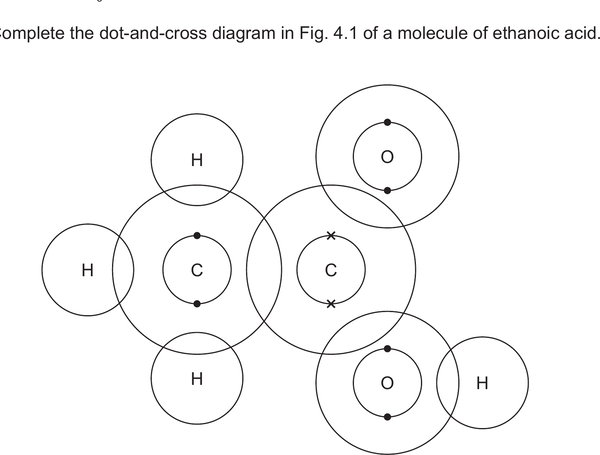
Mark scheme example: Dot-and-cross diagram (covalent bonding)

Dot-and-cross diagram (covalent bonding)

Show shared electron pairs in the overlap region. Show ALL outer shell electrons, including lone pairs.

Common error: Omitting lone pairs on atoms like oxygen and nitrogen. Drawing too few or too many electrons.

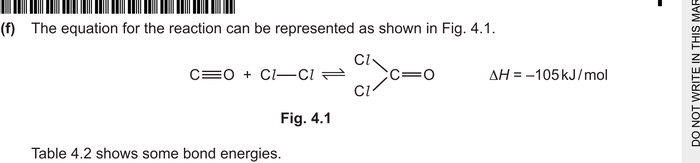
Mark scheme example: Displayed formula (organic compounds)

Displayed formula (organic compounds)

Show EVERY bond as a line. All atoms must be written with correct symbols. Double bonds shown as =.

Common error: Pentavalent carbon (5 bonds on C) and divalent hydrogen (2 bonds on H). Missing the O–H bond in alcohols and carboxylic acids. Forgetting to show all C–H bonds.

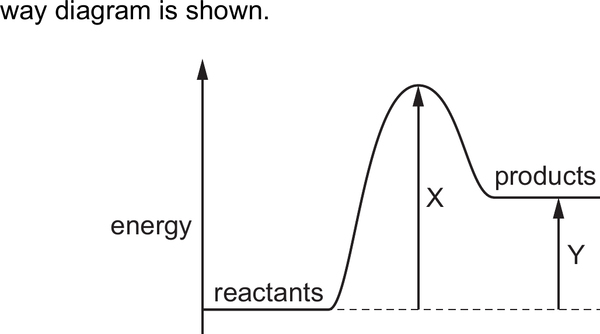
Mark scheme example: Energy level diagram (exothermic/endothermic)

Energy level diagram (exothermic/endothermic)

Axes: Progress of reaction × Energy

Horizontal lines for reactants and products, with an arrow showing ΔH. Activation energy hump between them.

Common error: Drawing an endothermic diagram for an exothermic reaction. Not labelling ΔH and activation energy. Confusing ΔH with activation energy.

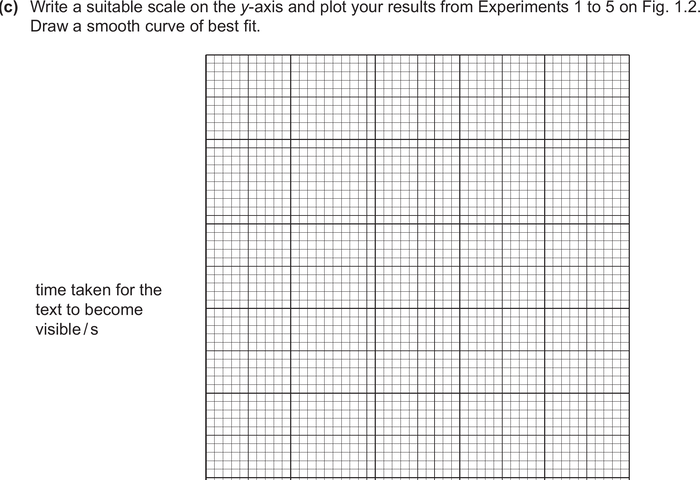
Mark scheme example: Graph plotting (Paper 5/6)

Graph plotting (Paper 5/6)

Axes: Independent variable (with units) × Dependent variable (with units)

Plot points with × or circled dots. Draw a smooth line of best fit — can be curved or straight depending on data. Labels and units on both axes.

Common error: Using awkward scales (3, 7, 9 per grid square — use 1, 2, 5 only). Forcing a straight line through clearly curved data. Not using at least half the grid area.

⚠️

Topics Students Struggle With Most In IGCSE Chemistry 0620

These IGCSE Chemistry 0620 topics consistently produce the lowest scores. Prioritise these in your revision.

!

Qualitative analysis and ion tests

Every examiner report flags this as a major weakness. Halide tests (acidified AgNO₃: Cl⁻=white, Br⁻=cream, I⁻=yellow precipitate), sulfate test (acidified BaCl₂ → white precipitate), flame test colours, and gas tests are consistently poorly recalled.

Affects: Paper 1/2, Paper 3/4, Paper 5/6

!

Organic chemistry — displayed formulae, naming, and functional groups

Examiners note: 'Most of the questions on organic chemistry were challenging.' Students confuse ethane/ethene, forget O–H bonds in alcohols and carboxylic acids, draw pentavalent carbons, and cannot name esters or draw polymer repeat units correctly.

Affects: Paper 1/2, Paper 3/4

!

Dynamic equilibrium — definition and Le Chatelier applications

Students say 'concentrations are equal' instead of 'constant', omit 'rate' from the definition, and use incorrect language like 'shifts to the endothermic side'. The correct terms are 'shifts to the left/right'.

Affects: Paper 3/4

!

Electrolysis — aqueous vs molten products

Students consistently predict sodium at the cathode in aqueous NaCl electrolysis. The rule is simple: reactive metals (above H in reactivity series) are NOT produced in aqueous solution — hydrogen forms instead.

Affects: Paper 1/2, Paper 3/4

!

Kinetic particle model — arrangement, separation, and motion

Students confuse arrangement with motion, write 'particles are separated' (just restating the question), or give vague descriptions. Must be specific: solid = fixed positions vibrating; liquid = close together sliding past each other; gas = far apart moving randomly at high speed.

Affects: Paper 3/4

!

Environmental chemistry — pollutant sources and solutions

Students cannot name specific sources ('cars' is too vague — say 'exhaust fumes from vehicles') or specific solutions to acid rain and climate change. Adverse effects of SO₂, CO, and CH₄ are frequently confused.

Affects: Paper 3/4

!

Rates of reaction — collision theory with correct language

Students write 'more collisions' instead of 'greater frequency of collisions'. Few mention that 'a greater proportion of particles have energy greater than or equal to the activation energy' when explaining temperature effects.

Affects: Paper 3/4

!

Blast furnace reactions and role of limestone

Students don't know that: (1) coke burns in hot air to form CO₂, (2) CO₂ reacts with more coke to form CO, (3) CO reduces iron ore, (4) limestone decomposes to CaO which removes SiO₂ impurities as slag. 'Calcium carbonate is a catalyst' is a common wrong answer.

Affects: Paper 3/4

!

Salt preparation methods

Students confuse filtrate with residue, don't know the crystallisation method (heat to point of crystallisation, cool, filter, dry with filter paper), and rarely know that titration is used for soluble salts from soluble bases.

Affects: Paper 3/4

Target your weak areas

The topics above are where most marks are lost. Use past papers and mark schemes to practice these specific areas until they become second nature.

Frequently Asked Questions

What topic do students struggle with most in IGCSE Chemistry?

Qualitative analysis (ion tests, gas tests, indicator colours). Examiners consistently report 'large gaps in knowledge'. Make flashcards for halide tests, sulfate test, flame tests, and gas tests.

How do I define dynamic equilibrium correctly?

Two key points: (1) the RATE of the forward reaction equals the RATE of the reverse reaction, (2) the concentrations of reactants and products are CONSTANT (not equal). Saying 'concentrations are equal' is wrong.

Should I use bullet points or full sentences in the exam?

Examiners explicitly recommend bullet points or short sentences. This reduces the risk of contradicting yourself — a correct point followed by an incorrect one can cancel out the mark.

What organic chemistry errors should I avoid?

Three big ones: (1) Wrong valencies — carbon must have 4 bonds, hydrogen 1, oxygen 2. (2) Missing the O–H bond in carboxylic acids/alcohols. (3) Not using IUPAC naming — write 'propan-1-ol' not just 'propanol'.

What papers make up Cambridge IGCSE Chemistry 0620?

Core: Paper 1 (MCQ, 40 marks) + Paper 3 (theory, 80 marks). Extended: Paper 2 (MCQ, 40 marks) + Paper 4 (theory, 80 marks). Plus Paper 5 (practical) or Paper 6 (alternative to practical, 40 marks).

How many examiner reports were used for this exam guide?

This guide is built from 10 official Cambridge examiner reports spanning 2021–2025, covering all paper components. Every insight is directly cited — no generic study tips.

Methodology: Analysis of 8 official Cambridge IGCSE examiner reports covering Papers 1–6 across Core and Extended tiers (2023–2025). All examiner quotes are taken directly from official Cambridge Assessment International Education principal examiner reports. Question references correspond to specific past paper questions. This guide is updated when new examiner reports are released. Last updated: 2026-04-10.