Subject-specialist worked solutions — every mark explained. Topical & Yearly Solved, Revision Notes, Predicted Papers. Explore →

Exam Intelligence · 3 Official Documents Analysed

How to Score Higher in Cambridge IGCSE Economics (0455)

Evidence-based Economics 0455 exam guide built from official examiner reports and mark schemes. Specialised and comprehensive study tips — specific, cited insights so you can achieve top grades.

Evidence-BasedBuilt from 3 official examiner reports & mark schemes (2023–2025)

What Are Assessment Objectives (AOs)?

Before we dive in, you need to understand how Cambridge actually marks your answers.

AO stands for Assessment Objective. Think of AOs as the different “skills” Cambridge tests you on in every single question. When an examiner marks your paper, they don't just give you a mark out of 12 based on how “good” your answer feels — they allocate specific marks to each AO separately.

For example, a 12-mark question might be split as: AO1 (2 marks) + AO2 (2 marks) + AO3 (2 marks) + AO4 (6 marks). If you write a perfect textbook answer but don't evaluate, you can only score 6 out of 12 — because the other 6 marks are specifically reserved for evaluation.

This is why understanding AOs matters: they tell you exactly what the examiner is looking for and how many marks each skill is worth. Here are the 3 AOs for this subject:
AO1

Knowledge and Understanding

40%

Demonstrate knowledge and understanding of economic concepts, terms, and theories.

AO2

Analysis

40%

Analyse economic issues and arguments using appropriate economic reasoning, diagrams, and data.

AO3

Evaluation

20%

Evaluate economic information, arguments, and policies, making reasoned judgements.

The key takeaway: Most students lose marks not because they lack knowledge (AO1), but because they skip the higher-order skills — building chains of reasoning (AO2) and making supported judgements (AO3). Everything below shows you exactly how to hit each AO based on what examiners have written in their reports.

🚫

Top Mistakes in IGCSE Economics 0455

The most common reasons students lose marks in IGCSE Economics 0455, cited directly from official examiner reports across multiple sessions.

1

Confusing budget deficit with current account deficit

Flagged in every session, Paper 2 · Affects: Paper 2

What examiners say

Some candidates confused a government budget deficit with a deficit on the current account of the balance of payments

0455 Paper 2, June 2023

How to fix this

Budget deficit = government spends more than it receives in tax revenue (fiscal). Current account deficit = a country imports more goods/services than it exports (trade). These are completely different — one is about government finances, the other is about international trade.

2

PED calculation and interpretation errors — confusing elastic with inelastic

Both sessions, Paper 1 · Affects: Paper 1

How to fix this

PED = % change in quantity demanded ÷ % change in price. If PED > 1, demand is elastic (responsive). If PED < 1, demand is inelastic (unresponsive). Always check: did quantity change by a LARGER or smaller percentage than price? Larger = elastic.

3

Demand vs quantity demanded — confusing shifts with movements along the curve

Both sessions, Paper 1 · Affects: Paper 1

How to fix this

A change in PRICE causes a movement along the demand curve (change in quantity demanded). A change in a NON-PRICE factor (income, tastes, substitutes) causes the whole curve to SHIFT (change in demand). Use the correct terminology — examiners distinguish between them.

4

Explaining consequences when asked for causes (and vice versa)

Both sessions, Paper 2 · Affects: Paper 2

How to fix this

Read the question carefully. 'Explain the causes of inflation' needs factors that LEAD TO inflation. 'Explain the consequences of inflation' needs effects that RESULT FROM inflation. Underline 'causes' or 'consequences' before writing.

5

Jumping analytical stages instead of step-by-step reasoning

Both sessions, Paper 2 · Affects: Paper 2

What examiners say

candidates do better if they do not jump stages

0455 Paper 2, March 2025

How to fix this

Show every step in the chain: event → immediate effect → further consequence → final outcome. For example: 'Minimum wage rises → firms' labour costs increase → firms may raise prices → demand for products may fall → unemployment could rise.' Each step earns marks.

6

Not using source material in Section A

Both sessions, Paper 2 · Affects: Paper 2

How to fix this

Section A is a data response question — you MUST reference the source material (tables, charts, text extracts). Quote specific figures and data points. Generic answers that ignore the source lose application marks.

7

Confusing productivity with production

Both sessions, Paper 2 · Affects: Paper 2

What examiners say

Recognise that productivity does not have the same meaning as production

0455 Paper 2, June 2023

How to fix this

Production = total output (how much is made). Productivity = output PER unit of input (how efficiently it is made). A factory can increase production by hiring more workers without improving productivity. Productivity rises when more is produced with the SAME resources.

8

PES confused with PED

Both sessions, Paper 2 · Affects: Paper 2

How to fix this

PED measures how BUYERS respond to price changes (demand side). PES measures how SELLERS respond to price changes (supply side). PED uses quantity demanded; PES uses quantity supplied. Keep them separate by asking: am I analysing buyers or sellers?

Apply what you've learned

Practice identifying these mistakes in real papers. Try a recent paper and mark yourself — you'll spot these patterns immediately.

What IGCSE Economics 0455 Examiners Reward

Patterns that consistently earn high marks in IGCSE Economics 0455, based on examiner report commentary on top-scoring answers.

Step-by-step chains of reasoning without jumping stages

Candidates who show each logical step — cause → immediate effect → secondary effect → conclusion — consistently score higher. The examiner explicitly states 'candidates do better if they do not jump stages.'

Source: 0455 Paper 2, March 2025

Using source data with specific figures in Section A

High-scoring answers in Section A quote exact numbers from the source material and use them to support arguments, rather than giving generic textbook responses.

Source: 0455 Paper 2, June 2023

Drawing clearly labelled diagrams to support written answers

Candidates who include relevant supply/demand or PPC diagrams with correct labels and shifts earn additional marks and demonstrate stronger understanding.

Source: 0455 Paper 2, March 2025

Distinguishing clearly between similar concepts

Top candidates explicitly define terms before using them, avoiding the common confusions (budget vs current account deficit, productivity vs production, PED vs PES).

Source: 0455 Paper 2, June 2023

📝

IGCSE Economics 0455 Answer Frameworks

Structured approaches for each IGCSE Economics 0455 question type, derived from mark scheme requirements.

Paper 2 Section A — Data Response (compulsory)

30–35 minutes

Structure

Reference source data with specific figures → Apply economic theory → Analyse step-by-step → Evaluate with a judgement

  • Quote specific numbers from the source in every answer
  • Do not write generic answers — use the data provided
  • For 'discuss' questions, consider both sides before concluding
  • Draw a diagram if relevant (supply/demand, PPC)

Paper 2 Section B — Structured Questions (choose 3 of 4)

20–25 minutes per question

Structure

Define key term → Explain with step-by-step reasoning → Analyse causes/consequences → Evaluate both sides with judgement

  • Choose questions on your strongest topics — read all four before deciding
  • Never jump stages: show every step in your reasoning chain
  • Use diagrams to support your analysis where appropriate
  • For 'discuss' parts, give both advantages AND disadvantages before concluding

Paper 1 — Multiple Choice Strategy

90 seconds per question average

Structure

Read the stem carefully → Eliminate obviously wrong options → Check for common traps → Select the best answer

  • Watch for demand vs quantity demanded (shift vs movement)
  • Check PED calculations: elastic > 1, inelastic < 1
  • Distinguish monetary (interest rates) from fiscal (tax/spending) policy
  • Budget deficit ≠ current account deficit — read carefully

Practice by topic

Use topical past papers to practice specific question types. Each topic collects questions from multiple years — perfect for drilling the frameworks above.

💬

IGCSE Economics 0455 Command Words Decoded

Each command word in IGCSE Economics 0455 is a scoring instruction. Understanding what examiners expect is critical to earning full marks.

define1–2 marks

Give the precise meaning of an economic term. Must be technically accurate.

Common mistake

Giving a vague everyday meaning instead of the economic definition.

identify1 mark

State or name a relevant point, often from source material. No explanation needed.

Common mistake

Writing long explanations when a single clear statement is sufficient.

explain2–4 marks

Show WHY or HOW something happens using step-by-step economic reasoning.

Common mistake

Jumping stages — missing intermediate steps in the chain of reasoning.

analyse4–6 marks

Break down an economic issue by examining causes, effects, and connections in detail.

Common mistake

Explaining consequences when asked for causes, or listing points without developing a chain.

discuss6–8 marks

Present arguments on both sides of an economic issue and reach a supported conclusion.

Common mistake

Only arguing one side or reaching a conclusion without weighing up both sides.

calculate1–3 marks

Show the formula, substitution, and answer with correct units.

Common mistake

Forgetting to show working or omitting units/percentage signs.

📐

IGCSE Economics 0455 Diagram Checklist

Incorrect diagrams in IGCSE Economics 0455 are flagged in every examiner report. Use this checklist before every practice and in the exam.

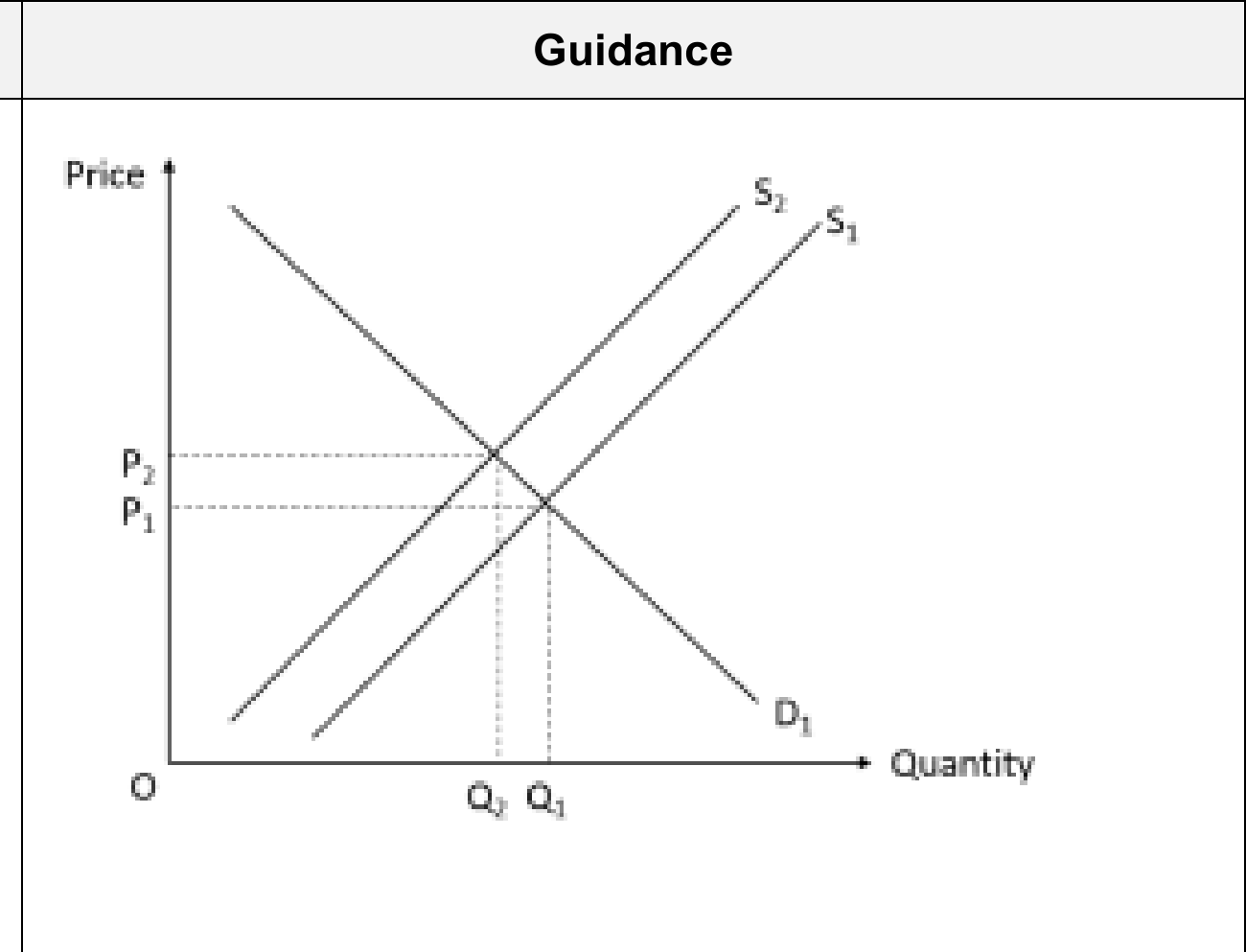
Mark scheme example: Supply and demand diagram

Supply and demand diagram

Any question about price changes, market equilibrium, shifts in supply or demand, price elasticity, government intervention (price floors/ceilings), or indirect taxes/subsidies.

Common error: Forgetting to label axes (Price on Y, Quantity on X), equilibrium point, or the direction of curve shifts.

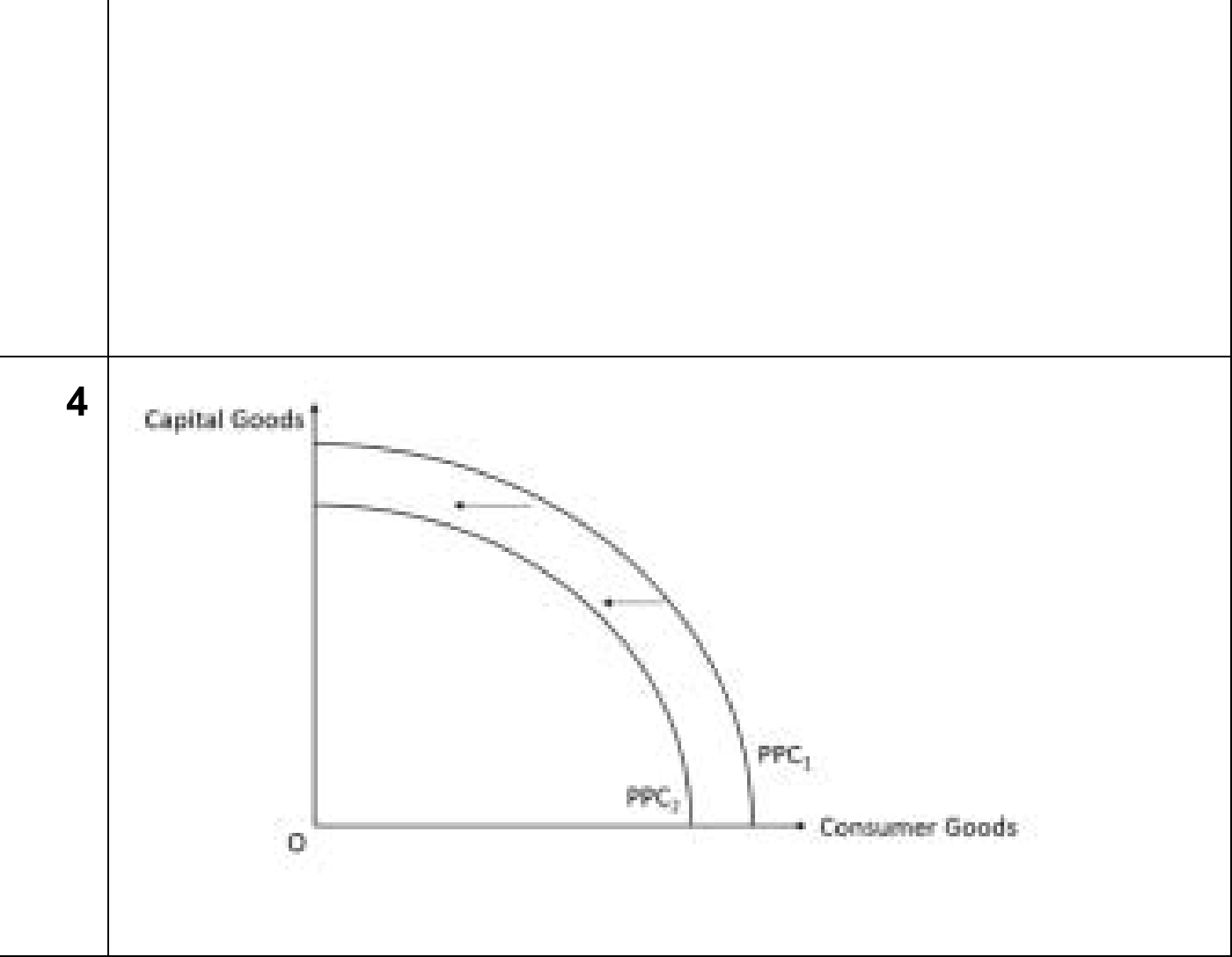
Mark scheme example: Production possibility curve (PPC) diagram

Production possibility curve (PPC) diagram

Questions about opportunity cost, economic growth, resource allocation, or the effects of investment/technology on productive capacity.

Common error: Not showing the shift outward for economic growth or failing to illustrate opportunity cost as movement along the curve.

⚠️

Topics Students Struggle With Most In IGCSE Economics 0455

These IGCSE Economics 0455 topics consistently produce the lowest scores. Prioritise these in your revision.

!

PED interpretation

Candidates consistently miscalculate PED or confuse elastic with inelastic. Common error: stating demand is elastic when PED < 1.

Affects: Paper 1, Paper 2

!

Balance of payments

Confused with government budget deficit in every session. Candidates struggle to distinguish the current account from the capital/financial account.

Affects: Paper 2

!

Foreign exchange rates

Candidates struggle to explain how exchange rates are determined by supply and demand for currencies, and confuse appreciation with depreciation.

Affects: Paper 1, Paper 2

!

Public goods definition

Candidates define public goods as 'goods provided by the government' instead of using the correct characteristics: non-excludable and non-rivalrous.

Affects: Paper 1, Paper 2

!

Simultaneous supply and demand shifts

When both curves shift, candidates fail to identify which outcome is indeterminate (price or quantity) depending on relative magnitudes.

Affects: Paper 1

!

Cost curves and diseconomies of scale

Candidates can explain economies of scale but struggle to explain why average costs might rise as a firm grows beyond its optimal size.

Affects: Paper 1, Paper 2

!

Monetary vs fiscal policy

Examiners note candidates had to distinguish monetary policy measures from fiscal policy measures and many could not.

Affects: Paper 1, Paper 2

!

Causes of deflation

Candidates often confuse deflation with disinflation and cannot explain demand-side vs supply-side causes of falling price levels.

Affects: Paper 2

Target your weak areas

The topics above are where most marks are lost. Use past papers and mark schemes to practice these specific areas until they become second nature.

Frequently Asked Questions

What topics are weakest in IGCSE Economics?

PED interpretation, balance of payments vs budget deficit, foreign exchange rate mechanisms, public goods (non-rival/non-excludable), simultaneous supply and demand shifts, cost curves and diseconomies, monetary vs fiscal policy distinction, and causes of deflation.

What papers make up Cambridge IGCSE Economics 0455?

Paper 1: Multiple Choice (30 marks, 45 minutes, 30 questions). Paper 2: Structured Questions (90 marks, 2h 15m) with Section A (compulsory data response) and Section B (choose 3 from 4 structured questions).

Should I draw diagrams in Paper 2?

Yes — supply/demand diagrams, PPC diagrams, and cost curves earn extra marks when relevant. Label axes, equilibrium points, and shifts clearly. Diagrams support your written analysis and demonstrate understanding.

How many examiner reports were used for this guide?

3 official Cambridge examiner reports covering 2023–2025 sessions. Every insight is directly cited from these documents.

Methodology: Analysis of 3 official Cambridge examiner reports (2023–2025). All examiner quotes are taken directly from official Cambridge Assessment International Education principal examiner reports. Question references correspond to specific past paper questions. This guide is updated when new examiner reports are released. Last updated: 2026-04-17.