Subject-specialist worked solutions — every mark explained. Topical & Yearly Solved, Revision Notes, Predicted Papers. Explore →

Exam Intelligence · 5 Official Documents Analysed

How to Score Higher in Cambridge IGCSE Mathematics (0580)

Evidence-based Mathematics 0580 exam guide built from official examiner reports and mark schemes. Specialised and comprehensive study tips — specific, cited insights so you can achieve top grades.

Evidence-BasedBuilt from 5 official examiner reports & mark schemes (2023–2025)

What Are Assessment Objectives (AOs)?

Before we dive in, you need to understand how Cambridge actually marks your answers.

AO stands for Assessment Objective. Think of AOs as the different “skills” Cambridge tests you on in every single question. When an examiner marks your paper, they don't just give you a mark out of 12 based on how “good” your answer feels — they allocate specific marks to each AO separately.

For example, a 12-mark question might be split as: AO1 (2 marks) + AO2 (2 marks) + AO3 (2 marks) + AO4 (6 marks). If you write a perfect textbook answer but don't evaluate, you can only score 6 out of 12 — because the other 6 marks are specifically reserved for evaluation.

This is why understanding AOs matters: they tell you exactly what the examiner is looking for and how many marks each skill is worth. Here are the 2 AOs for this subject:

AO1

Knowledge and understanding of mathematical techniques

40–50% (Extended); 60–70% (Core)

Organise, interpret, and present information in written, graphical, and diagrammatic forms. Perform calculations by suitable methods, with and without a calculator. Use mathematical instruments and equipment.

AO2

Analyse, interpret and communicate mathematically

50–60% (Extended); 30–40% (Core)

Apply combinations of mathematical skills and techniques to solve problems, including multi-step and unstructured problems. Communicate solutions clearly, showing method at each stage.

The key takeaway: Most students lose marks not because they lack knowledge (AO1), but because they skip the higher-order skills — building chains of reasoning (AO2) and making supported judgements (AO3). Everything below shows you exactly how to hit each AO based on what examiners have written in their reports.

🚫

Top Mistakes in IGCSE Mathematics 0580

The most common reasons students lose marks in IGCSE Mathematics 0580, cited directly from official examiner reports across multiple sessions.

1

Not showing working — writing only the final answer

Flagged in every examiner report across all papers (2023–2025) · Affects: Paper 1, Paper 2, Paper 3, Paper 4

What examiners say

When calculations of two or more steps are needed, it is best if each step is shown separately for candidates' checking their own work and for method marks to be awarded.

Paper 1, May/June 2023

Candidates giving only solutions from their calculator without showing all the working as requested in the question did not score full marks.

Paper 4, March 2025

How to fix this

Show every step: formula → substitution → calculation → answer. Even on calculator papers, write the formula used and the values substituted. For quadratic equations, show the full quadratic formula with values — calculator-only answers earn zero method marks.

2

Premature rounding — not keeping 4+ significant figures through working

Every session, all papers · Affects: Paper 2, Paper 3, Paper 4

What examiners say

At least 4 figure accuracy should be used throughout the steps of the method if the final answer is to have 3 significant figure accuracy.

Paper 2, March 2023

Intermediate values within longer methods should not be rounded with only the final answer rounded to the appropriate degree of accuracy.

Paper 4, March 2025

How to fix this

Keep at least 4 significant figures through ALL intermediate steps. Only round the FINAL answer. Use the pi button on your calculator, not 3.14 or 22/7. For time: use exact fractions like 10/3 hours, not 3.33.

3

Using wrong geometric reasoning vocabulary

Every session, Papers 2, 3, 4 · Affects: Paper 2, Paper 3, Paper 4

What examiners say

'Z angles' is not accepted as this is the shape made with the parallel lines and not the proper reason — alternate angles.

Paper 1, May/June 2023

Candidates must understand the demand to 'give a geometrical reason' means the use of correct vocabulary is expected, rather than descriptions in non-mathematical language.

Paper 2, May/June 2023

How to fix this

Learn the exact terms: 'alternate angles' (not Z angles), 'co-interior angles sum to 180°' (not C angles), 'corresponding angles', 'angles in a semicircle = 90°', 'angle at centre = 2× angle at circumference', 'opposite angles of cyclic quadrilateral sum to 180°', 'tangent perpendicular to radius'.

4

'Show that' — working backwards from the given answer

Every session, Papers 3, 4 · Affects: Paper 3, Paper 4

What examiners say

Candidates were expected to arrive at 32.0(00) in order to conclude that the angle was approximately 32. Many started by assuming the angle was 32 and came back full circle. Such an approach will not score full marks.

Paper 4, May/June 2023

How to fix this

In 'show that' questions: work TOWARDS the given answer, not FROM it. Show the answer to more decimal places than given (e.g. show 32.000 to prove it rounds to 32). Never assume the result you're trying to prove.

5

Describing two transformations when 'single transformation' is asked

Every session, Papers 2, 4 · Affects: Paper 2, Paper 4

What examiners say

A number of candidates failed to follow the instruction to describe using a single transformation, and hence did not gain marks.

Paper 2, May/June 2023

How to fix this

When asked for a 'single transformation': give exactly ONE (translation, rotation, reflection, or enlargement). Two transformations = ZERO marks. For each, include ALL required details — rotation needs: centre, angle, direction; enlargement needs: centre, scale factor; translation needs: column vector.

6

Confusing 100 minutes = 1 hour, and time conversion errors

Multiple sessions, Papers 1, 3, 4 · Affects: Paper 1, Paper 3, Paper 4

What examiners say

The common error of thinking there were 100 minutes in one hour was seen a number of times.

Paper 1, March 2025

The time was given as 3 hours 20 minutes and an accurate value such as 10/3 should be used. The incorrect conversion of 3.20 was common.

Paper 4, May/June 2023

How to fix this

1 hour = 60 minutes (not 100). To convert 3h 20min to hours: 20/60 = 1/3, so 3h 20min = 10/3 hours. NEVER write 3.20 hours for 3h 20min. For 12-hour time: always include am/pm.

7

Quadratic formula sign errors — especially with negative b

Every session, Papers 2, 4 · Affects: Paper 2, Paper 4

What examiners say

(−b) written as −3 rather than −(−3) or writing b² as −3² rather than (−3)².

Paper 4, May/June 2023

How to fix this

When b is negative (e.g. b = -3): write −b = −(−3) = 3 and b² = (−3)² = 9. The most common error is writing −3² = −9 instead of (−3)² = 9. Use brackets around negative numbers every time.

8

Non-calculator arithmetic — using calculator methods by hand

Every Paper 1 and Paper 2 report · Affects: Paper 1, Paper 2

What examiners say

Candidates need to focus on efficient arithmetic strategies for a non-calculator paper. There were a number of questions where students attempted to perform calculations in the same way that they would with the assistance of a calculator.

Paper 2, March 2025

How to fix this

On non-calculator papers: use mental shortcuts, factor where possible, simplify before multiplying. If the question gives you a calculation hint (e.g. a multiplication table), USE it instead of doing long multiplication. Practice non-calculator arithmetic regularly.

Apply what you've learned

Practice identifying these mistakes in real papers. Try a recent paper and mark yourself — you'll spot these patterns immediately.

What IGCSE Mathematics 0580 Examiners Reward

Patterns that consistently earn high marks in IGCSE Mathematics 0580, based on examiner report commentary on top-scoring answers.

Showing each step of working separately

Even with a wrong final answer, clear method earns method marks (M marks). Each visible correct step is an opportunity for marks via follow-through.

Source: All papers, 2023–2025

Using efficient non-calculator strategies

Candidates who 'chose a method to make the arithmetic easy' scored better and had more time. Those who did long multiplication/division by hand often ran out of time and made errors.

Source: Paper 2, March 2025

Using correct mathematical vocabulary for geometric reasons

'Give a geometrical reason' requires proper terms: 'alternate angles', 'co-interior angles', 'angle at centre = 2× angle at circumference'. Calculations or descriptions in everyday language earn zero.

Source: Paper 2, May/June 2023

Keeping exact values through multi-step calculations

Using exact fractions for time (10/3 instead of 3.33) and calculator pi (not 3.14) avoids accuracy mark losses. 'A small number of candidates used pi = 3.14 which gave an inaccurate answer.'

Source: Paper 4, March 2025

Drawing ruled diagrams — histograms, box plots, constructions

Freehand histograms and box plots lose marks. 'Histograms were expected to be accurate and ideally ruled.' Use a ruler for all statistical diagrams and constructions.

Source: Paper 4, May/June 2023

Checking answers are sensible for the context

'Check all answers to see if they are sensible for the context of the question.' A negative length, a probability > 1, or a person's age of 150 should trigger a re-check.

Source: Paper 1, March 2025

📝

IGCSE Mathematics 0580 Answer Frameworks

Structured approaches for each IGCSE Mathematics 0580 question type, derived from mark scheme requirements.

'Show that' questions (2–4 marks)

3–5 minutes

Structure

Start from given information → work step by step → arrive at printed result with MORE decimal places than given.

  • Work TOWARDS the answer, never FROM it
  • Show more accuracy than the given value (e.g. show 32.000 to prove ≈ 32)
  • Never substitute the given answer into your working
  • If your working doesn't reach the answer, check for errors — don't fudge

Transformation description (2–3 marks)

1–2 minutes

Structure

Name the single transformation → give ALL required details

  • Rotation: centre (as coordinates), angle, direction (clockwise/anticlockwise)
  • Reflection: equation of the mirror line
  • Translation: column vector
  • Enlargement: centre (as coordinates), scale factor (can be negative or fractional)
  • TWO transformations = ZERO marks

Trigonometry with sine/cosine rule (3–5 marks)

4–6 minutes

Structure

Identify which rule to use → substitute values → solve for the unknown

  • Sine rule for: angle-side-angle or side-angle-side (non-included)
  • Cosine rule for: side-angle-side (included) or side-side-side
  • After sine rule: check if the angle could be obtuse (180° - θ)
  • Don't evaluate trig inverses too early — keep exact expressions

Histogram / frequency density (2–4 marks)

3–5 minutes

Structure

Calculate frequency density (frequency ÷ class width) → draw bars with RULED edges

  • Frequency density = frequency / class width — NOT just frequency
  • Bar width represents the class width
  • Use a ruler — freehand bars lose marks
  • Area of bar = frequency (this is how to read histograms too)

Probability without replacement (2–3 marks)

3–4 minutes

Structure

Draw a tree diagram → multiply along branches → add for 'or' scenarios

  • Without replacement: second set of fractions has a smaller denominator
  • Account for BOTH orders: P(A then B) + P(B then A)
  • Common error: forgetting to multiply by 2 for both-order scenarios
  • Use fractions not decimals — exact probabilities are cleaner

Practice by topic

Use topical past papers to practice specific question types. Each topic collects questions from multiple years — perfect for drilling the frameworks above.

💬

IGCSE Mathematics 0580 Command Words Decoded

Each command word in IGCSE Mathematics 0580 is a scoring instruction. Understanding what examiners expect is critical to earning full marks.

show that2–4 marks

Prove the given result. Work towards it, showing more accuracy than given.

Common mistake

Working backwards from the answer. Using the given result in the proof.

estimate2 marks

Round each number first (usually to 1 sf), THEN calculate with rounded values.

Common mistake

Calculating with original values then rounding the answer. Must round FIRST.

describe the single transformation2–3 marks

Name ONE transformation with ALL required details (centre, angle, vector, etc.).

Common mistake

Giving two transformations = zero marks. Missing required details (e.g. centre of rotation).

give a geometrical reason1 mark

State the circle theorem or angle property using correct mathematical vocabulary.

Common mistake

Describing with calculations or everyday language. 'Z angles' is not accepted — say 'alternate angles'.

simplify1–2 marks

Reduce the expression to its simplest form. Collect like terms, cancel common factors.

Common mistake

Not fully simplifying — leaving unsimplified fractions or uncollected terms.

sketch2–3 marks

Draw the general shape with key features (intercepts, turning points). Not a precise plot.

Common mistake

Drawing a table of values and plotting points. Joining curve points with straight lines.

📐

IGCSE Mathematics 0580 Diagram Checklist

Incorrect diagrams in IGCSE Mathematics 0580 are flagged in every examiner report. Use this checklist before every practice and in the exam.

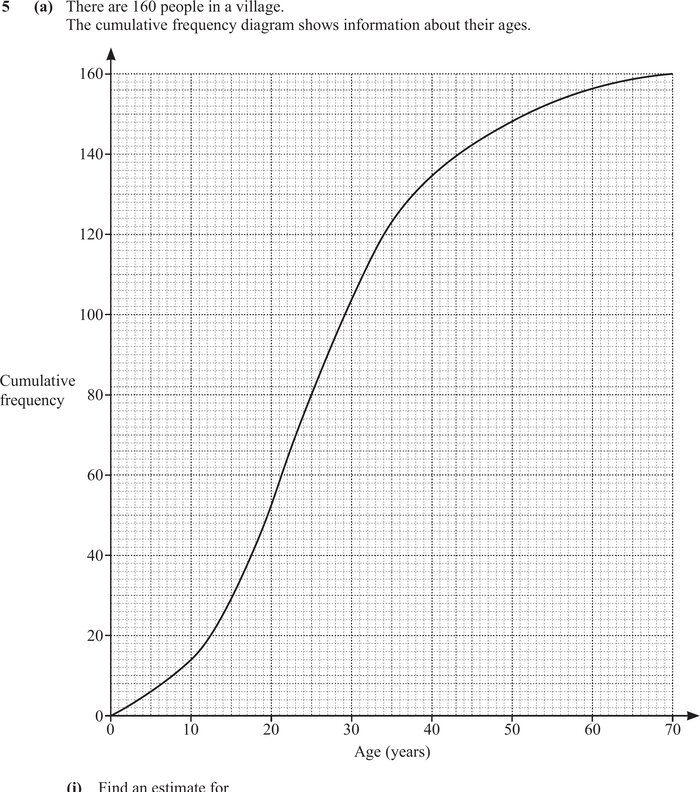
Mark scheme example: Cumulative frequency curve

Cumulative frequency curve

Axes: Upper class boundary × Cumulative frequency

Plot at upper class boundaries (NOT at mid-values or integers). Draw a smooth S-shaped curve through the points — NOT straight-line segments.

Common error: Plotting at class mid-values. Drawing straight-line segments (cumulative frequency polygon) instead of a smooth curve.

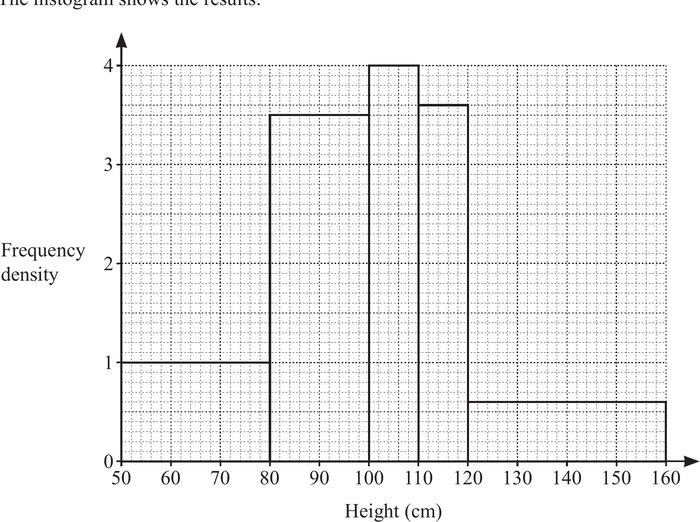
Mark scheme example: Histogram

Histogram

Axes: Continuous variable × Frequency density

Bar heights = frequency density. Bar widths = class widths. Use a ruler. No gaps between bars.

Common error: Using frequency instead of frequency density. Freehand bars. Unequal class widths not reflected in bar widths.

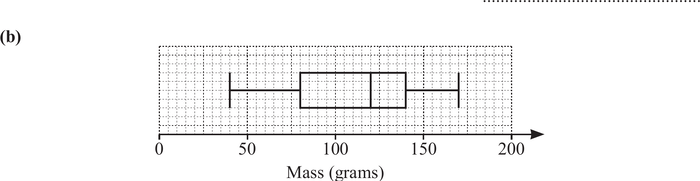
Mark scheme example: Box-and-whisker plot

Box-and-whisker plot

Axes: Value scale × N/A

Box from lower quartile to upper quartile. Line inside box at median. Whiskers to minimum and maximum. Use a ruler.

Common error: Not using a ruler. Confusing median with mean. Drawing whiskers to wrong values.

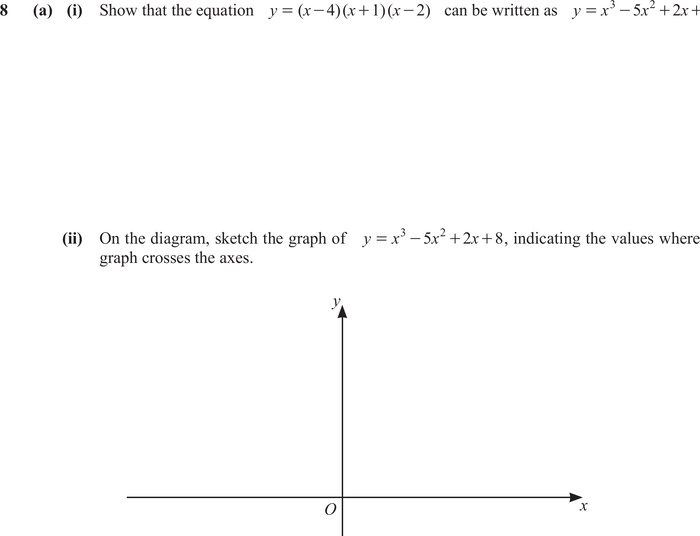
Mark scheme example: Graph sketching (quadratic, cubic, trig)

Graph sketching (quadratic, cubic, trig)

Axes: x × y

Smooth curve through plotted points. Show correct shape. Label intercepts and turning points.

Common error: Joining plotted points with straight-line segments. Not showing smooth curves at turning points. Missing the line of symmetry of a quadratic.

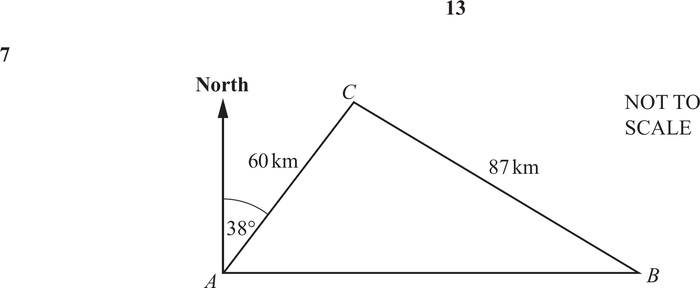
Mark scheme example: Bearings diagram

Bearings diagram

North line at each point. Measure angle clockwise from North. Three-digit format (e.g. 073°, not 73°).

Common error: Measuring anticlockwise. Forgetting three-digit format. Not drawing North lines at each relevant point.

⚠️

Topics Students Struggle With Most In IGCSE Mathematics 0580

These IGCSE Mathematics 0580 topics consistently produce the lowest scores. Prioritise these in your revision.

!

Bearings — drawing and calculating with sine/cosine rule

Drawing the bearing of 215° and calculating reverse bearings are consistently poorly answered. Students measure anticlockwise or forget the three-digit format.

Affects: Paper 3, Paper 4

!

Histogram frequency density

'Many drew bars of various heights from incorrect calculations for frequency density.' Students use frequency instead of frequency density, and draw freehand bars.

Affects: Paper 4

!

Circle theorem vocabulary and geometric reasoning

Students describe angles using everyday language or calculations instead of proper terms. 'Z angles', 'F angles', and 'C angles' earn zero — must use 'alternate', 'corresponding', 'co-interior'.

Affects: Paper 2, Paper 4

!

3D trigonometry — identifying the correct triangle

'It was rare to see this part answered well with most candidates unable to visualise which angle was needed.' Students struggle to identify which right-angled triangle to use in 3D problems.

Affects: Paper 4

!

Algebraic fractions and rationalising denominators

On non-calculator papers, combining algebraic fractions over a common denominator and rationalising surds are consistently weak. Sign errors when expanding brackets are common.

Affects: Paper 2

!

Recurring decimals to fractions

'Candidates multiplied by successive powers of ten and then subtracted incorrectly due to not making the recurring decimal element cancel.' The method of 10x - x or 100x - x is poorly understood.

Affects: Paper 2

!

Vectors — routes and position vectors

Direction errors like AE = BA, incorrect use of ratios (AE = 4/5 AB instead of correct proportion), and confusing column vectors with coordinates are common.

Affects: Paper 4

!

Differentiation — stationary points and tangent equations

Students omit the constant term when differentiating (e.g. differentiating -x to 0 instead of -1). Finding the gradient by dividing coordinates instead of drawing a tangent is common.

Affects: Paper 2, Paper 4

Target your weak areas

The topics above are where most marks are lost. Use past papers and mark schemes to practice these specific areas until they become second nature.

Frequently Asked Questions

What are the most common topics students struggle with in IGCSE Maths?

Bearings with trig, histogram frequency density, circle theorem vocabulary, 3D trigonometry, algebraic fractions, recurring decimals to fractions, and vectors. These appear as weak areas in every examiner report.

Why is 'Z angles' not accepted as a geometric reason?

Examiners require proper mathematical vocabulary. 'Z angles' describes the shape, not the property. The correct term is 'alternate angles'. Similarly, use 'co-interior angles' not 'C angles', and 'corresponding angles' not 'F angles'.

What papers make up Cambridge IGCSE Mathematics 0580?

Core: Paper 1 (non-calculator, 80 marks) + Paper 3 (calculator, 80 marks). Extended: Paper 2 (non-calculator, 100 marks) + Paper 4 (calculator, 100 marks). Extended candidates take Papers 2 and 4.

Can I use 3.14 for pi on calculator papers?

No. Use the pi button on your calculator (or 3.142 minimum). Using 3.14 or 22/7 gives an inaccurate answer that loses the accuracy mark.

How many examiner reports were used for this guide?

This guide is built from 3 official Cambridge examiner reports and 2 mark schemes covering 2023–2025. Every insight is directly cited from these documents.

Methodology: Analysis of 3 official Cambridge IGCSE examiner reports and 2 mark schemes (2023–2025). All examiner quotes are taken directly from official Cambridge Assessment International Education principal examiner reports. Question references correspond to specific past paper questions. This guide is updated when new examiner reports are released. Last updated: 2026-04-16.