Subject-specialist worked solutions — every mark explained. Topical & Yearly Solved, Revision Notes, Predicted Papers. Explore →

Exam Intelligence · 5 Official Documents Analysed

How to Score Higher in Cambridge IGCSE Physics (0625)

Evidence-based Physics 0625 exam guide built from official examiner reports and mark schemes. Specialised and comprehensive study tips — specific, cited insights so you can achieve top grades.

Evidence-BasedBuilt from 5 official examiner reports & mark schemes (2023–2025)

What Are Assessment Objectives (AOs)?

Before we dive in, you need to understand how Cambridge actually marks your answers.

AO stands for Assessment Objective. Think of AOs as the different “skills” Cambridge tests you on in every single question. When an examiner marks your paper, they don't just give you a mark out of 12 based on how “good” your answer feels — they allocate specific marks to each AO separately.

For example, a 12-mark question might be split as: AO1 (2 marks) + AO2 (2 marks) + AO3 (2 marks) + AO4 (6 marks). If you write a perfect textbook answer but don't evaluate, you can only score 6 out of 12 — because the other 6 marks are specifically reserved for evaluation.

This is why understanding AOs matters: they tell you exactly what the examiner is looking for and how many marks each skill is worth. Here are the 3 AOs for this subject:

AO1

Knowledge with Understanding

50%

Recall and demonstrate understanding of physics facts, definitions, quantities, units, and concepts. Definitions must be precise — 'force per unit area' not 'force on an area'. Use syllabus symbols (E not Q for energy).

AO2

Handling Information and Problem Solving

30%

Interpret data, perform calculations, and apply physics knowledge. Always show the formula, substitute values, and give the answer with correct units to 2 significant figures minimum.

AO3

Experimental Skills and Investigations

20%

Plan experiments, record measurements to instrument resolution, plot graphs with crosses (not blobs), draw lines of best fit, and evaluate methods. Sources of inaccuracy must be inherent to the method, not about poor practice.

The key takeaway: Most students lose marks not because they lack knowledge (AO1), but because they skip the higher-order skills — building chains of reasoning (AO2) and making supported judgements (AO3). Everything below shows you exactly how to hit each AO based on what examiners have written in their reports.

🚫

Top Mistakes in IGCSE Physics 0625

The most common reasons students lose marks in IGCSE Physics 0625, cited directly from official examiner reports across multiple sessions.

1

Unit conversion errors — minutes to hours, kW to W, cm to m, km³ to m³

Every examiner report, all papers (2023–2025) · Affects: Paper 1/2, Paper 3/4

What examiners say

Incorrect answers chosen involved using an incorrect equation, not converting minutes to hours or not converting watts to kilowatts.

Paper 1, May/June 2023

It proved difficult for most candidates to calculate the correct mass because they were unable to convert km³ to m³ where a multiplication factor of (1000)³ was required.

Paper 4, May/June 2023

How to fix this

Write every conversion: 1 hour = 60 min (not 100). 1 kW = 1000 W. 1 km = 1000 m, so 1 km³ = (1000)³ m³ = 10⁹ m³. For time: 3h 20min = 10/3 hours (not 3.20). Always convert BEFORE substituting into equations.

2

Equation rearrangement errors — dividing instead of multiplying

Every session, Papers 1/2 and 3/4 · Affects: Paper 1/2, Paper 3/4

What examiners say

The most common incorrect answer was option A, indicating that candidates had not rearranged the equation correctly and instead they divided force by distance.

Paper 1, May/June 2023

Common errors included using an incorrect rearrangement of speed = distance / time, e.g., distance = speed / time.

Paper 3, March 2025

How to fix this

Write the formula first. Then rearrange algebraically BEFORE substituting numbers. Check: if speed = distance/time, then distance = speed × time (multiply, not divide). Use the formula triangle if needed, but always verify the rearrangement makes sense.

3

'Show that' questions — manipulating numbers without stating the formula

Every session, Papers 3/4 · Affects: Paper 3/4

What examiners say

When asked to 'show that' a quantity has a particular value, candidates must demonstrate that they know the formula they are applying. Manipulation of numbers given in the question to achieve the correct numerical answer is insufficient.

Paper 4, May/June 2023

How to fix this

For 'show that': (1) Write the formula in words or symbols. (2) Substitute ALL values with units. (3) Calculate to more decimal places than the given answer. (4) State the conclusion. Just rearranging the given numbers without showing the physics earns zero.

4

Electromagnetic induction — not understood at all

Consistently the weakest topic across all sessions · Affects: Paper 3/4

What examiners say

The concept of electromagnetic induction was not well understood by most candidates. Very few stated that the wire would cut the magnetic field lines of the magnet when it moved.

Paper 3, May/June 2023

The majority of candidates showed little understanding of how to induce an e.m.f. in a copper wire in a magnetic field and thought that a power supply was required.

Paper 1, March 2025

How to fix this

To induce an EMF: a conductor must MOVE through (cut) magnetic field lines, OR a magnetic field must CHANGE through a coil. No battery or power supply is needed — the movement itself generates the EMF. A.C. in the primary coil of a transformer creates a changing magnetic field that induces EMF in the secondary.

5

Mass vs weight confusion — even at Extended level

Every session, Papers 1/2 · Affects: Paper 1/2

What examiners say

Only stronger candidates answered this correctly, with the majority confusing weight and mass and therefore choosing option A.

Paper 1, May/June 2023

How to fix this

Mass = amount of matter (kg, measured with balance, same everywhere). Weight = gravitational force on an object (N, measured with newton-meter, changes with location). Weight = mass × g. An object on the Moon has the SAME mass but LESS weight.

6

Constant velocity means balanced forces — not understood

Every session, Papers 1/2 and 3/4 · Affects: Paper 1/2, Paper 3/4

What examiners say

Many candidates had the misconception that the frictional forces must be less than the driving force, but not zero, when the cyclist travels at constant speed.

Paper 1, May/June 2023

How to fix this

At constant velocity: resultant force = 0, so driving force = total resistive force. The forces are BALANCED. If driving force > friction, the object ACCELERATES. If driving force < friction, the object DECELERATES. Only when they're equal does velocity stay constant.

7

Imprecise definitions — missing 'per unit' or giving wrong quantity

Every session, Papers 3/4 · Affects: Paper 3/4

What examiners say

Many said that force acted on an object but did not relate this to area. A common answer was to refer to 'a certain area' rather than unit area.

Paper 4, May/June 2023

No credit was given for the use of Q instead of E or t instead of theta or T.

Paper 4, May/June 2023

How to fix this

Pressure = force PER UNIT AREA (not 'force on an area'). Density = mass PER UNIT VOLUME. Use syllabus symbols: E for energy (not Q), θ for temperature (not t), n for neutron (not N). Every 'per unit' phrase is a separate mark point.

8

Plotting blobs instead of crosses on graphs, forcing line through origin

Every Paper 5/6 report · Affects: Paper 5/6

What examiners say

Candidates should use neat crosses for the plots, or neatly circled dots so that the accuracy of the plotting can be assessed.

Paper 5, May/June 2023

Few candidates gained credit for the line of best fit, with many just joining the first and last points.

Paper 5, March 2025

How to fix this

Plot with × crosses (not dots or blobs). Line of best fit: must have points balanced above and below — do NOT force through the origin unless data supports it, and do NOT just connect first to last point. Use scales of 1, 2, or 5 per grid square — never 3, 7, or 9.

Apply what you've learned

Practice identifying these mistakes in real papers. Try a recent paper and mark yourself — you'll spot these patterns immediately.

What IGCSE Physics 0625 Examiners Reward

Patterns that consistently earn high marks in IGCSE Physics 0625, based on examiner report commentary on top-scoring answers.

Writing the formula before substituting values

'Show that' questions require demonstrating knowledge of the formula. Writing it earns the first mark even if calculation goes wrong. 'Manipulation of numbers without stating the formula is insufficient.'

Source: Paper 4, May/June 2023

Including units with every final answer

'A numerical answer must always be accompanied by the correct unit.' Missing units loses the answer mark even when the number is correct.

Source: Paper 4, March 2025

Showing all working for partial credit

'If a final numerical answer is incorrect, partial credit may sometimes be awarded for a clearly presented supporting calculation. Incorrect answers without working cannot be awarded credit.'

Source: Paper 3/4, all sessions

Using precise physics vocabulary in explanations

'Convection' explanations must say 'heated water becomes less dense' not 'heated water particles become less dense'. 'Nuclei splitting' not 'atoms splitting'. Precision in language = precision in marks.

Source: Paper 3/4, multiple sessions

Recording measurements to full instrument resolution

Ruler with mm markings: record to nearest mm (15.0 cm, not 15 cm). Stopwatch: to 0.01 s. This is checked by examiners and earns a separate mark.

Source: Paper 5, March 2025

Using comparative language — 'more stable' not 'stable'

'The question asked for the effect on stability so the comparative more stable was needed. Answers such as this helps stability were insufficient.'

Source: Paper 4, March 2023

📝

IGCSE Physics 0625 Answer Frameworks

Structured approaches for each IGCSE Physics 0625 question type, derived from mark scheme requirements.

'Show that' questions (2–3 marks)

2–3 minutes

Structure

Write formula → substitute values with units → calculate → state answer to more dp than given

  • Write the formula first — this earns the first mark
  • Show unit conversions explicitly
  • Calculate to more decimal places than the printed answer
  • Do NOT work backwards from the given value

Calculation questions (2–4 marks)

3–5 minutes

Structure

Formula → rearrange → convert units → substitute → answer with units to 2 sf

  • Rearrange the formula BEFORE substituting numbers
  • Convert ALL units to SI base units first (m, kg, s, A)
  • Give answers to at least 2 significant figures
  • Always include the unit in the final answer

Electromagnetic induction explanation (2–3 marks)

2–3 minutes

Structure

Identify the conductor and field → state relative motion → explain induced EMF

  • An EMF is induced when a conductor CUTS magnetic field lines (relative motion)
  • No battery or power supply is needed
  • Changing the field through a coil also induces EMF
  • In transformers: A.C. in primary → changing field → induced EMF in secondary

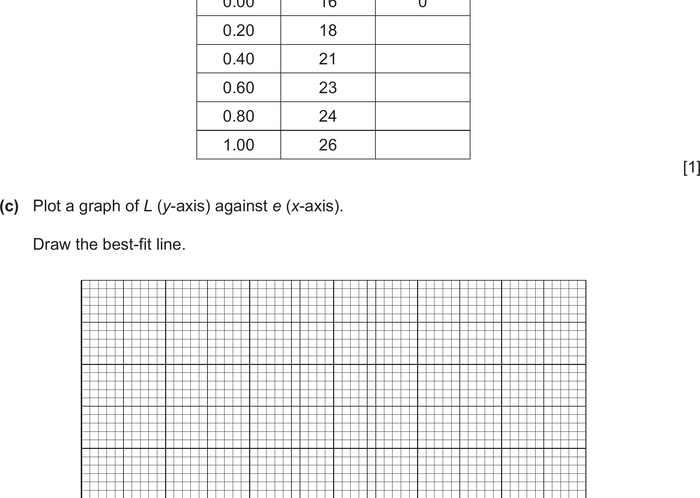
Graph plotting (Paper 5/6, 3–5 marks)

5–8 minutes

Structure

Choose sensible scales → plot with × crosses → draw line of best fit → read values for gradient

  • Scales: use 1, 2, or 5 per large grid square — NEVER 3, 7, or 9
  • Plot with × crosses, not dots or blobs
  • Line of best fit: points balanced above and below. Can be curved.
  • Do NOT force through the origin unless data supports it
  • Do NOT just join first point to last point

Practice by topic

Use topical past papers to practice specific question types. Each topic collects questions from multiple years — perfect for drilling the frameworks above.

💬

IGCSE Physics 0625 Command Words Decoded

Each command word in IGCSE Physics 0625 is a scoring instruction. Understanding what examiners expect is critical to earning full marks.

define1–2 marks

Give the precise definition using correct physics terms.

Common mistake

Giving vague wording. 'Pressure is force per unit area' not 'force on a certain area'.

show that2–3 marks

State the formula, substitute values with units, calculate to more accuracy than given.

Common mistake

Just manipulating numbers without stating which formula is being used.

state1 mark

Give a brief, precise answer.

Common mistake

Writing too much — a single correct sentence is enough.

explain2–3 marks

Give the physics reason — cause and effect.

Common mistake

Describing what happens without giving the physics WHY.

describe1–2 marks

State what happens — observations, not reasons.

Common mistake

Explaining the physics when only a description of the effect is needed.

📐

IGCSE Physics 0625 Diagram Checklist

Incorrect diagrams in IGCSE Physics 0625 are flagged in every examiner report. Use this checklist before every practice and in the exam.

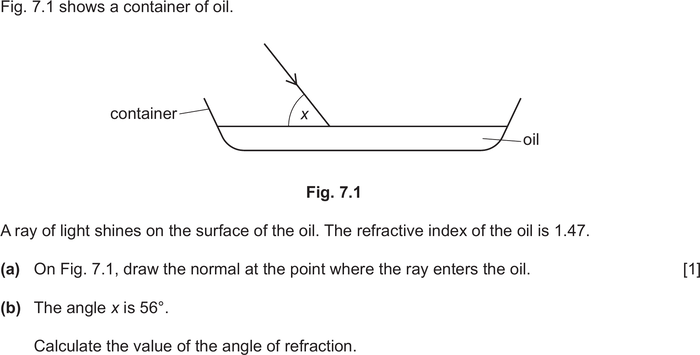
Mark scheme example: Refraction at a surface

Refraction at a surface

Draw the normal (perpendicular to surface). Angle of incidence measured from the NORMAL, not the surface. Ray bends towards normal when entering a denser medium.

Common error: Measuring the angle from the surface instead of from the normal. Drawing the normal in the wrong position.

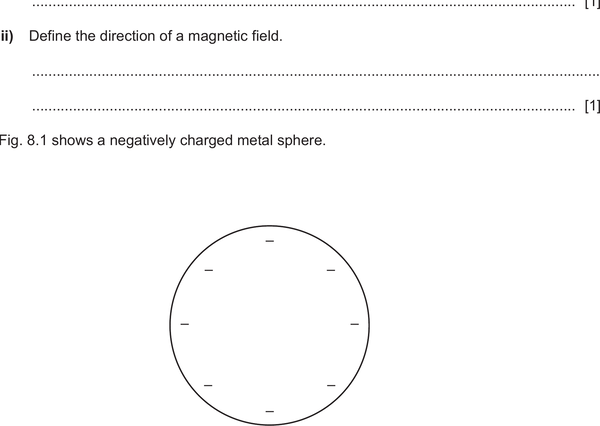
Mark scheme example: Electric field around a charged sphere

Electric field around a charged sphere

Radial lines pointing away from positive charge (or towards negative). Equally spaced around the sphere. Arrows show direction of force on a positive test charge.

Common error: Not showing arrows on field lines. Lines not equally spaced. Lines not radial (must point directly away from/towards centre).

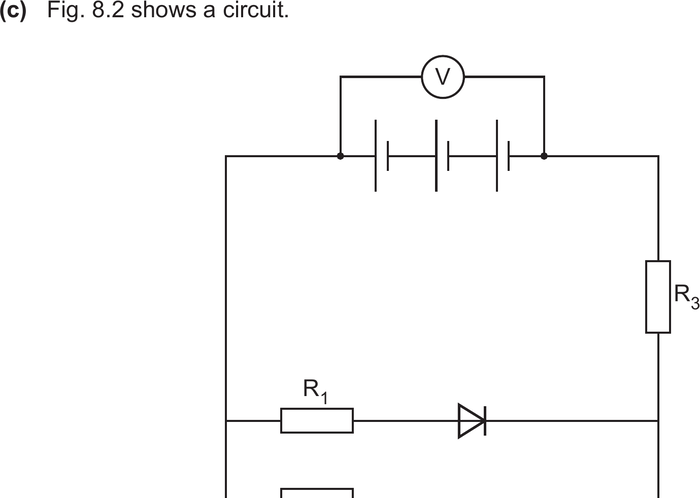
Mark scheme example: Circuit diagram (series and parallel components)

Circuit diagram (series and parallel components)

Use correct circuit symbols from the syllabus. Ammeter in series. Voltmeter in parallel. Complete circuit with no gaps.

Common error: Voltmeter drawn in series. Using wrong symbols. Incomplete circuit (gaps in wires).

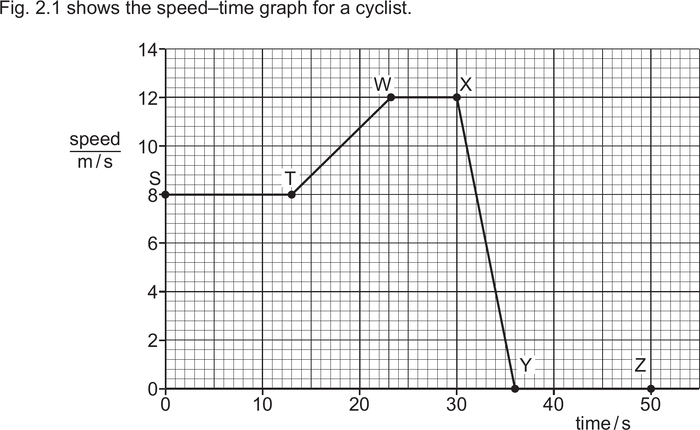
Mark scheme example: Speed-time graph interpretation

Speed-time graph interpretation

Axes: Time / s × Speed / m s⁻¹

Horizontal line = constant speed. Positive gradient = acceleration. Area under graph = distance travelled.

Common error: Using gradient for distance (gradient = acceleration). Confusing speed-time graphs with distance-time graphs.

Mark scheme example: Graph plotting (Paper 5/6)

Graph plotting (Paper 5/6)

Axes: Independent variable (with units) × Dependent variable (with units)

Plot with × crosses. Line of best fit with points balanced above and below. Scales of 1, 2, or 5 per grid square.

Common error: Using blobs instead of crosses. Forcing line through origin. Joining first to last point. Using awkward scales (3, 7, 9).

⚠️

Topics Students Struggle With Most In IGCSE Physics 0625

These IGCSE Physics 0625 topics consistently produce the lowest scores. Prioritise these in your revision.

!

Electromagnetic induction

Consistently the weakest topic. 'The majority showed little understanding of how to induce an EMF and thought a power supply was required.' Motor vs generator confusion is widespread.

Affects: Paper 1/2, Paper 3/4

!

Moments and equilibrium — perpendicular distance

Students use raw meter-rule readings instead of distances from the pivot. At constant velocity, resultant force = 0 (not 'slightly unbalanced').

Affects: Paper 1/2, Paper 3/4

!

Speed-time vs distance-time graph interpretation

'The majority of candidates struggled and many incorrectly chose option D where the graph looked exactly the same.' Students use d = s × t instead of area under the graph.

Affects: Paper 1/2

!

Total internal reflection and critical angle

'The topic of total internal reflection was poorly understood by the vast majority.' Students think the ray must travel from air into water (it's the reverse — dense to less dense medium).

Affects: Paper 3/4

!

Potential divider circuits

'Few candidates recognised that the circuit was connected as a potential divider.' Students say current is divided instead of voltage. EMF is shared between components in proportion to resistance.

Affects: Paper 3/4

!

Radioactive decay and half-life calculations

'The concept of half-life was not well understood by many candidates.' Students divide by the number of half-lives instead of halving repeatedly. Background count not subtracted.

Affects: Paper 1/2, Paper 3/4

!

Space physics — seasons, star lifecycle, redshift

'A very common error was to state that winter was caused by an increase in the distance between Earth and the Sun.' Seasons are caused by axial tilt, not distance. Star lifecycle terminology (supergiant, not giant) matters.

Affects: Paper 3/4

!

Equation rearrangement and unit conversion

Students divide when they should multiply (distance = speed / time instead of speed × time). Converting km³ to m³ requires ×(1000)³ = ×10⁹, not ×1000.

Affects: Paper 1/2, Paper 3/4

Target your weak areas

The topics above are where most marks are lost. Use past papers and mark schemes to practice these specific areas until they become second nature.

Frequently Asked Questions

What topics are weakest in IGCSE Physics?

Electromagnetic induction, moments/equilibrium, speed-time vs distance-time graphs, total internal reflection, potential dividers, half-life calculations, and space physics (seasons, star lifecycle).

What papers make up Cambridge IGCSE Physics 0625?

Core: Paper 1 (MCQ, 40 marks) + Paper 3 (theory, 80 marks). Extended: Paper 2 (MCQ, 40 marks) + Paper 4 (theory, 80 marks). Plus Paper 5 (practical) or Paper 6 (alternative to practical, 40 marks).

Why does my V-I graph answer lose marks?

Resistance = V/I (the ratio at a point), not the gradient of the V-I graph. A straight line through the origin means constant resistance. A curve means changing resistance — calculate V/I at each point.

How many examiner reports were used for this guide?

3 official examiner reports and 2 mark schemes covering 2023–2025. Every insight is directly cited from these documents.

Methodology: Analysis of 3 official Cambridge IGCSE examiner reports and 2 mark schemes (2023–2025). All examiner quotes are taken directly from official Cambridge Assessment International Education principal examiner reports. Question references correspond to specific past paper questions. This guide is updated when new examiner reports are released. Last updated: 2026-04-16.